


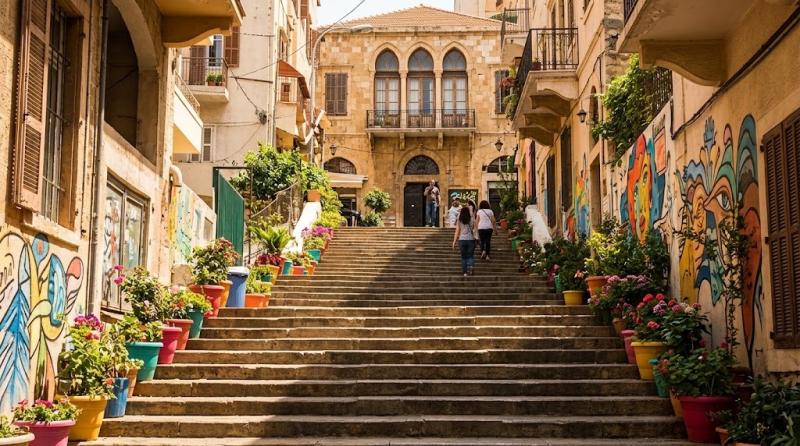
Located in Beirut between the Ashrafieh and Gemmayzeh areas, the Stairs of Mar Nicolas serve as a pedestrian pathway connecting parts of the city's historic urban fabric.
The stairs connect with Rue Sursock and Rue Gouraud, leading through a series of stone steps between old neighborhoods, near various heritage buildings, adding to its historical significance in Beirut's landscape.
The Beginnings of Mar Nicolas Stairs
The story of these stairs dates back to a time when Beirut relied on pathways and stairs to navigate between areas at different elevations.
Historical and journalistic sources indicate that the location was originally a steep earthen path locally known as 'Qadomeya', a route for pedestrians.
In the late Ottoman era, the path was paved with stones, becoming a clearer part of the network connecting Beirut's old neighborhoods.
Stairs in Beirut were not just architectural features but integral to daily life, offering shortcuts between neighborhoods separated by slopes.
The Mar Nicolas Stairs and Old Beirut Neighborhoods
Historically linked with Ashrafieh and Gemmayzeh, these stairs facilitated access between residential areas before modern road networks expanded.
During the 19th and 20th centuries, as Beirut expanded, Mar Nicolas Stairs retained their role as a pedestrian pathway despite the changing surrounding buildings and streets.
Why Are They Called Mar Nicolas Stairs?
The stairs are named after the Mar Nicolas area and church in Ashrafieh.
Sources suggest that the Mar Nicolas Church lent its name to the surrounding area, including the street and neighborhood, with Saint Nicholas becoming the area's patron.
Over time, the name "Mar Nicolas Stairs" became associated with the stone pathway linking parts of Ashrafieh and Gemmayzeh.
How Many Steps are There in Mar Nicolas?
The number of steps varies based on how the segments are counted. The Beirut Heritage Association counts it as the longest in Beirut, comprising about 200 steps, while other sources report varying figures.
This variability underscores the stairs' extent and the branching paths linked to surrounding neighborhoods.
From 'Stairs of the Fighters' to 'Stairs of Art'
Initially known as ‘Stairs of the Fighters’, the stairs were later dubbed ‘Stairs of Art’ due to their association with cultural events.
The name change reflects the stairs' role in hosting artistic activities, transforming it from a daily transit path to a cultural venue.
When Did It Become a Space for Art?
In recent decades, Mar Nicolas Stairs became a venue for art events in Beirut, hosting outdoor exhibitions and various cultural activities.
The stairs' open-air design allows audiences to sit and enjoy performances, creating a natural amphitheater.
Restoration of Mar Nicolas Stairs
Increased interest in preserving urban heritage has led to the restoration of Mar Nicolas Stairs, presenting them as a cultural landmark in Beirut.
According to Al-Qafila Magazine, the stairs were restored in 1999, and subsequently became more associated with ‘Stairs of Art’, featuring exhibitions and performances.
The Importance of Mar Nicolas Stairs Today
The significance of the stairs lies not just in their steps or age but as witnesses to Beirut's transformations.
The site today offers a rich blend of old architecture, stone pathways, heritage neighborhoods, and cultural activities, offering a unique pedestrian exploration of Beirut away from main roads.
Mar Nicolas Stairs and Beirut's Memory
Mar Nicolas encapsulates aspects of old Beirut when narrow steps and pathways were vital daily routes. Today, they are part of the city's memory and cultural scene.
The advent of modern roads has overshadowed many such paths, highlighting the importance of preserving these historical facets of Beirut's urban fabric.