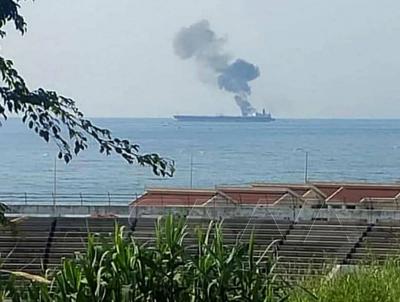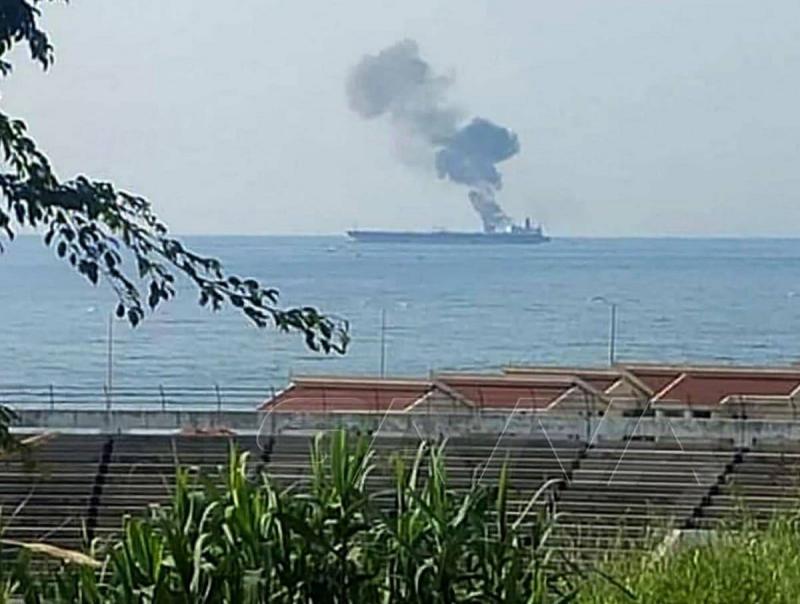
Last night, a new chapter unfolded along the Syrian coast in the ongoing "covert" war between Israel and Iran, marked by attacks on ships over the past months. After the Syrian regime's Ministry of Oil announced that firefighting teams managed to extinguish a fire that erupted in one of the tanker's oil storage tanks off the Baniyas refinery, it hinted that the vessel was targeted, likely by a drone from the direction of Lebanese territorial waters, adding a new element to the situation.
### Registered in Beirut
Also, the TankerTrackers service tweeted early Sunday that the "mentioned tanker is not Iranian" but registered in Beirut, providing another complicating detail that perhaps clarifies the methods Iran is using to evade the imposed restrictions on its oil exports. They added that the tanker is named "Wisdom," and it previously assisted the Iranian supertanker ARMAN 114 (similar to ADRIAN DARYA-1) in unloading between 300,000 to 350,000 barrels of oil.
### A "Pain-free" War
Military analyst Ibrahim Al-Jabawi considered in statements to Al Arabiya that the targeting of the tanker off Baniyas is part of a "pain-free" war, as he described it, between Israel and Iran, indicating that both sides are assessing the damage and its implications. He also pointed out that there is information suggesting the presence of weapons in the tank.
### Contradictory Iranian Reports
The Iranian Al-Alam channel reported yesterday that the tanker is one of three Iranian oil tankers that recently reached the Baniyas oil port loaded with supplies, while the semi-official Tasnim news agency denied that the tanker was Iranian. The coastal city of Baniyas hosts an oil refinery that, along with another refinery in Homs, covers a significant portion of the demand for diesel, heating fuel, gasoline, and other petroleum products, according to industry experts.
Syria, ravaged by war, has faced severe shortages of gasoline and fuel over the past year, leading to supply rationing in government-controlled areas and increased prices. Moreover, Syria has increased its reliance on Iranian oil shipments in recent years. However, the tightening of Western sanctions on Iran, Syria, and their allies, coupled with the foreign currency crisis, has made it increasingly difficult to secure sufficient supplies.
This attack follows a series of mutual strikes targeting both Israeli and Iranian ships in recent months, indicating new messages exchanged between the two outside of land this time. According to Western and regional intelligence sources confirmed by Reuters, Israel has expanded its strikes on Iranian targets, including suspected arms production centers in Syria, in an effort to counter what it perceives as military expansion by its arch-enemy in the region.