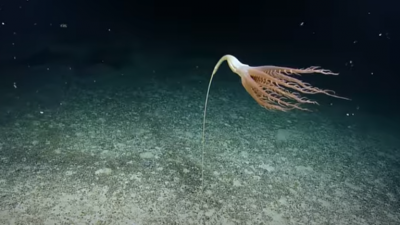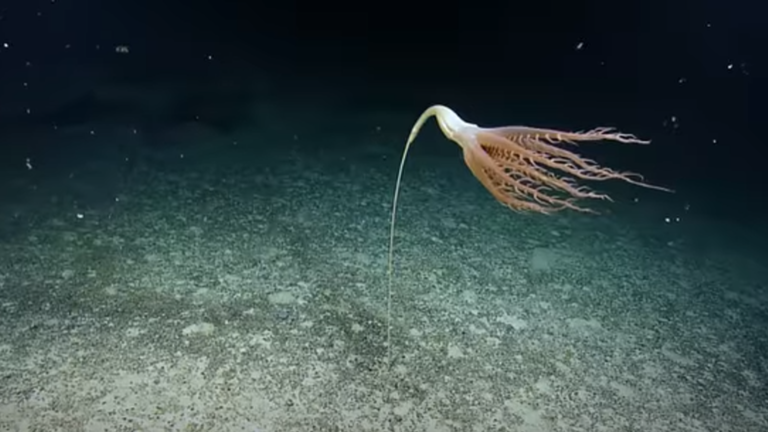
New footage showing a strange giant marine creature quietly floating in the Pacific Ocean has left researchers wondering if they are witnessing a new species. A team of scientists discovered the unusual animal while aboard the E/V Nautilus, a research vessel used by the Ocean Exploration Trust, a non-profit organization conducting deep-sea research, in a recently released video.
The expedition researchers set out for exploration, and while focusing on images of the strange creature, one of the scientists on board was heard saying "off camera" as the remotely operated vehicle (ROV) examined the ocean floor and approached the bizarre scene. Another scientist sarcastically remarked, "I'm not on the edge of my seat or anything."
The creature was spotted at a depth of 9,823 feet (2,994 meters) beneath the surface near an unexplored marine mountain north of Johnston Atoll, which is an unincorporated U.S. territory and a national wildlife refuge in the Pacific west of Hawaii. Initially, researchers suspected they might have crossed paths with Solumbellula monocephalus, also known as the sea pen Solumbellula, which is part of the Cnidaria phylum that includes jellyfish, hydra, and corals. However, the only known sightings of sea pens prior to this had occurred in the Atlantic and Indian Oceans, making it likely that scientists may have found a new species.
The chief researcher on the mission, deep-sea biologist and postdoctoral researcher at Boston University, Steve Oskavitch, described the observation as "remarkable." He told Live Science, "Every once in a while, we encounter something we never expect to see, and these observations often hold great significance." Oskavitch added, "We were nearing the end of our cruise and were on the ocean floor when we noticed the 'sea pen' we captured in the video was huge, probably the same size or larger than Hercules."
Oskavitch sought input from shore-based biologists who helped confirm his suspicions that it was a sea pen or closely related to corals, based on the impressive size of the animal. He believed it was relatively mature but could not determine its age, noting that sea pens reach maturity at around five or six years of age and can live for over a decade.
Oskavitch stated, "Previously, Solumbellula monocephalus had never been seen in the central Pacific and had never been collected." Interestingly, the discovery by his team came months after scientists in Spain named two new species of sea pens: Pseudumbellula and Solumbellula, the latter of which would include the new species. These findings were published in February in the journal Invertebrate Systematics. Oskavitch said more research is needed to determine if this is the first Solumbellula monocephalus in the Pacific or is potentially a new species in the ocean basin.