


With the reshaping of the IMEC global trade corridor, an unprecedented alliance of mayors, from Haifa to the Jordanian border, is determined to ensure the north doesn't fall behind again.
Forget the Suez Canal. Forget the old shipping lanes. A new trade corridor is being charted on the global map, running directly through Haifa Bay. If envisioned by a group of ambitious local leaders in Israel, this coastal strip is set to become one of the most strategically significant sites on earth.
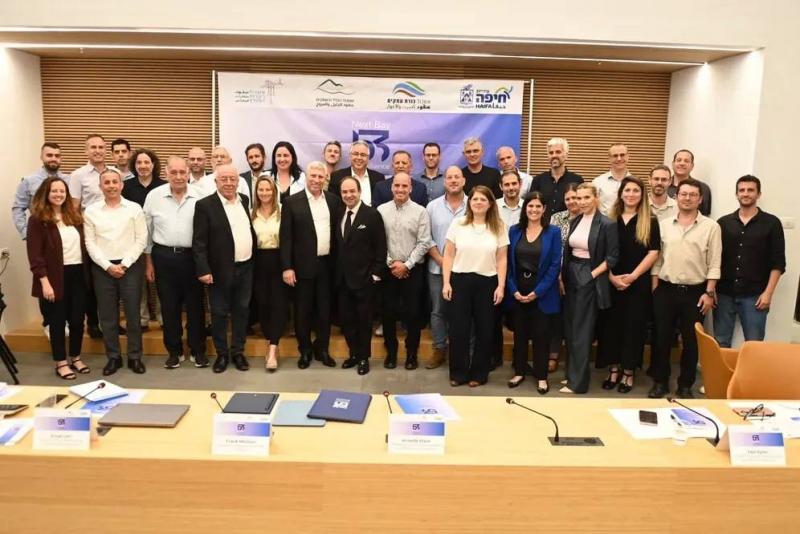
This ambition was clearly demonstrated this week when 53 local authorities—mayors, council heads, and assemblies from Haifa westward to the Jordan Valley eastward—convened to sign a joint charter and officially launch the “New Gulf” alliance. It is the first time such an event has occurred in Israel, and the reason for its timing is the complete story.
The New Silk Road
The India-Middle East-Europe Economic Corridor (IMEC) is the primary catalyst for this project. Imagine it as a new Silk Road connecting India via the Gulf States, reaching Israel, and then onward to Europe. It is advertised as capable of reducing shipping times between Asia and Europe by 40%, making Haifa Port a gateway to Europe from the East.
This is precisely why these 53 cities have decided they cannot wait and let others seize this opportunity.
Thanks to its strategic location and developed infrastructure, northern Israel—including Haifa Port, one of the largest ports in the Eastern Mediterranean—forms a major logistics hub along the IMEC corridor. As Israel’s maritime gateway to the region, it represents an important strategic asset for expanding trade and communication between Asia, the Middle East, and Europe.
David Even Tzur, Mayor of Kiryat Yam, expressed it simply: “This is a historic and celebratory day for our region. This partnership will offer opportunities for all the smaller municipalities to develop economically and socially.” For his city—with a population of 52,000 and a Mediterranean coastline stretching 2.5 kilometers—he sees a long-awaited dream finally coming within reach: “This initiative allows us to fulfill our city’s vision by developing tourism and hotels, so anyone coming here for business and investment finds a place to stay... This is the best chance we have had to achieve it.”
The “Next Bay” alliance encompasses three principal municipal clusters stretching from Haifa to Israel’s eastern border with Jordan. Thus, when it comes to developing the “IMEC” corridor, these 53 cities are raising their flag—asserting they are active partners in shaping what is being built here, not merely spectators watching what unfolds around them.
The Eastern Gateway
At the other end of the corridor lies Beit She’an, on the outskirts of Jordan. Its mayor, Noam Jumah, frames this moment from both a historical and economic perspective: “Beit She’an has always been a historic crossroads, where goods, information, and people traversed.”
Jumah sees this as an opportunity beyond just logistics, envisioning a revival of human relations alongside commercial ties. He states: “Both Jordan and Israel recognize this opportunity. The ability to develop student exchange programs to enable youth to come and get acquainted, transforming Beit She’an into a hub of international trade... When there is a shared economic interest—a significant interest—it also creates a shared social interest. This is our future, and we must be a part of it.”
Normalization Comes at a Price
There is a broader geopolitical story behind all this. The Abraham Accords have opened the door for Israel to establish open trade relations with the Gulf States. At its core, the International Trade Center (IMEC) embodies transforming that relationship into an economic relationship, where investments flow in ports, railways, clean energy, and technology in both directions. It's a process of normalization, but it comes at a price.
Nitzan Peleg, Head of the Regional Council of “Lower Galilee,” seeks to involve local leaders as genuine partners in planning the International Transport Corridor (IMEC) from the outset, not merely as an afterthought once major decisions are made elsewhere. With potential Israeli elections slated for next September or October, Peleg sees an urgent need to do things right now: “We need to prepare the next government with a clear plan, a plan we all sign off on, so it can implement and promote this corridor without overlooking the residents living along its route, in all municipalities.”
Peleg believes this opportunity surpasses and doesn't exclusively apply to the region's diversity: “We have economic sectors like energy, railway infrastructure, and tourism. Muslims, Jews, Haredim, Arabs, Druze, Circassians—we all live together in various municipalities, and our beautiful Galilee is a shared region between Israel and Jordan. So, I think merely being at the eastern gateway of the International Transport Corridor (IMEC) to Israel presents an excellent opportunity for developing tourism in this area.”