


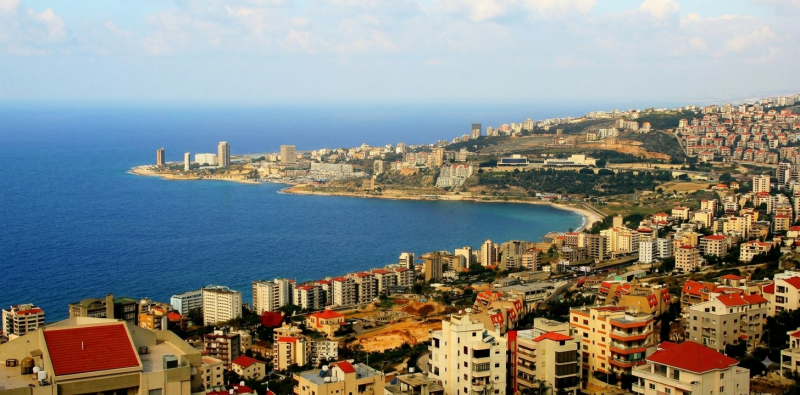
The size of cities isn't always solely measured by the number of residents within the administrative boundaries of a municipality. Urban areas can extend to connected towns and suburbs, as seen in Beirut and its suburbs, where the urban sprawl forms a much larger population cluster than the administrative capital alone.
Additionally, recent population data in Lebanon faces challenges due to the absence of a comprehensive national census and changes related to demographics, migration, and displacement. Therefore, the following ranking should be seen as an order of prominent Lebanese cities and urban clusters rather than an official final population count.
Top 10 Largest Cities in Lebanon
1. Beirut: Capital and Largest Urban Center in Lebanon
Beirut tops the list of Lebanon's largest cities, serving as the capital and main political, economic, and cultural hub of the country, housing state institutions, universities, companies, and media centers. A wide network of suburbs connects with the capital, forming a densely populated urban area.
Beirut's significance exceeds its population, acting as a primary economic and cultural center with diverse neighborhoods featuring modern buildings and historical areas. The concept of "Greater Beirut" further extends the population picture, connecting with the city from multiple directions, forming Lebanon's largest urban cluster.
{{PLACEHOLDER_0}}
2. Tripoli: Largest City in Northern Lebanon
Tripoli ranks high among Lebanese cities by population, often considered the second largest in the country. Located in northern Lebanon, it holds significant economic and historical importance, being the primary urban center for the northern governorate.
Famed for its rich Mamluk heritage, featuring numerous mosques, schools, khans, and historical markets, Tripoli showcases unique architectural appeal. Its port plays a vital role in its economic and geographical identity.
Moreover, Tripoli's high population density compared to its area makes it one of Lebanon's key urban centers, connected with surrounding areas, strengthening its role as a main hub in the north.
3. Sidon: Gateway to Southern Lebanon
Sidon holds a critical position among major Lebanese cities, serving as the administrative capital of the southern governorate and a significant population and commercial center in the region. The city's history dates back to Phoenician civilizations, maintaining several historical landmarks to this day.
Known for its coastal location, port, and old markets, alongside the Sea Castle, a famous city symbol, Sidon has played a crucial commercial role due to its location on Lebanon’s southern coast.
Additionally, Sidon functions as a center for services, education, and trade for many southern residents, establishing it as one of Lebanon's vital cities outside the capital.
4. Nabatieh: Prominent Urban Center in Southern Lebanon
Nabatieh, located in southern Lebanon, stands as an important administrative and economic center in the region. Despite lacking the coastal stretch that Sidon and Tyre enjoy, its inland position gives it a central role, linking many southern towns and regions.
Home to markets, institutions, and services, Nabatieh is a key center for surrounding residents. Its commercial and social history is notable, with markets becoming attractions for southern residents at certain times of the year.
Conversely, estimating Nabatieh's population size can vary based on how the city’s geographical scope is defined, given the assemblage of surrounding areas and towns.
5. Zahle: Heart of the Beqaa and Bride of Lebanese Cities
Zahle, known as the "Bride of the Beqaa," is a prominent city in Lebanon's interior, located on the eastern slopes of Mount Lebanon and serving as the administrative center of the Beqaa governorate, boasting substantial economic, commercial, and cultural importance.
Famed for its setting on the Berdawni River with restaurants, cafes, and mountain charm, Zahle holds a rich cultural and literary history, serving as a hub for numerous towns and villages in the Beqaa region.
Additionally, Zahle’s geographical position has bolstered its commercial significance, lying at the heart of the Beqaa plain, serving as a crossroads between various parts of Lebanon, making it an essential urban center outside the coast.
6. Tyre: A Phoenician City on the Southern Coast
Tyre is one of Lebanon's most famous historical cities, located on the southern coast with a rich mix of Phoenician, Roman, and Islamic heritage. Tyre's archaeological city was listed as a UNESCO World Heritage Site in 1984 due to its exceptional historical and archaeological value.
Part residential city, part coastal hub, Tyre also holds tourism significance with visitors exploring its archaeological sites, beaches, and historical landmarks.
The city serves as a central hub for southern Lebanon, surrounded by economically and socially connected towns and areas, giving it a role beyond its direct administrative size.
Globally renowned, Tyre's fame isn't solely based on its population size but rather its long history as one of the oldest cities in the Eastern Mediterranean.
7. Jounieh: Urban and Tourist Center North of Beirut
Jounieh, situated on the Lebanese coast north of the capital, serves as the administrative center of Keserwan, witnessing clear urban growth over recent decades, forming a significant part of the coastal urban stretch north of Beirut.
With its location between sea and mountains and proximity to major tourism destinations like Harissa and Jeita Grotto, Jounieh offers a seaside front with tourist and commercial facilities, making it one of the region's most active cities.
Moreover, Jounieh's connection with Beirut's northern suburbs widens its urban boundaries beyond municipal limits, causing population figures to vary depending on whether the source counts the administrative city or a broader urban cluster.
8. Baalbek: Largest Center of Northern Beqaa
Baalbek holds a special place among Lebanese cities, combining population and historical importance, serving as the center of Baalbek-Hermel governorate and a prominent city in the northern Beqaa region.
Globally known for its massive Roman ruins, including the temples of Jupiter and Bacchus, Baalbek ranks as one of Lebanon's top historical destinations, with its archaeological site listed as a UNESCO World Heritage Site.
Beyond tourism, the city functions as an administrative, commercial, and service hub for a vast area of northern Beqaa, maintaining its prominence as a major Lebanese urban center outside the coastal region.
{{PLACEHOLDER_1}}
9. Aley: Mountainous City with Population and Tourism Significance
Aley, located in Mount Lebanon, sits relatively close to Beirut and has evolved into a significant residential and tourism center, known for its high altitude and mountainous climate, historically being a well-known summer destination.
Balancing residential purposes with commercial and tourist activities, Aley connects with surrounding mountainous towns and villages. Its proximity to the capital furthers its role as a residential and recreational attraction.
During summer, tourism activity rises in the city and its vicinity, thanks to moderate weather, unlike the coastal areas, and the presence of many restaurants, cafes, and facilities enhancing its tourist status.
10. Byblos: Historical City Transforming into an Urban and Tourist Center
Byblos rounds off this list of Lebanese cities, known as one of the oldest continuously inhabited cities globally. The city, historically known as "Byblos," ties its name to its Phoenician history and papyrus trade, linking its name historically to books.
Featuring an ancient harbor, fortress, and archaeological sites, Byblos stands as a top tourist destination in Lebanon, with its archaeological site included in the UNESCO World Heritage list in 1984.
Recently, the city's urban and tourist landscapes have visibly developed, expanding commercial, dining, and tourist activities. Byblos blends its residential city role with international tourist appeal.
Understanding the Ranking of Lebanese Cities by Population
It's crucial to highlight that ranking Lebanese cities by population isn't a completely fixed matter. Figures can vary when comparing only the municipality's residents to the urban area's residents or the city's connected cluster.
This variation partly stems from Lebanon's urban growth nature, where cities intermix with neighboring towns and suburbs, notably in Beirut and Mount Lebanon. Additionally, demographic changes, migration, and economic shifts in recent years impacted population distribution.
Why Are Lebanon's Largest Cities Concentrated on the Coast and Plains?
The distribution of major cities in Lebanon clearly relates to their geographical settings, with the coastal area providing easy access to main roads, ports, and services, while the Beqaa plain offers a broader space for agricultural and urban activities compared to steep mountainous areas.
Consequently, Beirut, Tripoli, Sidon, Tyre, Jounieh, and Byblos are located on or near the coast. Meanwhile, Zahle, Baalbek, and Nabatieh represent key urban centers inland.
Furthermore, Lebanon's economic history supports this distribution, with many coastal cities formed around ports and trade, while inland cities evolved as administrative centers and regional markets serving surrounding areas.
In conclusion, these cities reflect Lebanon's diversity, combining a modern capital with historical cities, coastal hubs, mountain centers, and Beqaa and southern cities, forming a small yet rich urban network in history, culture, and economy.
See Also
5 Facts About the Sea in Lebanon