


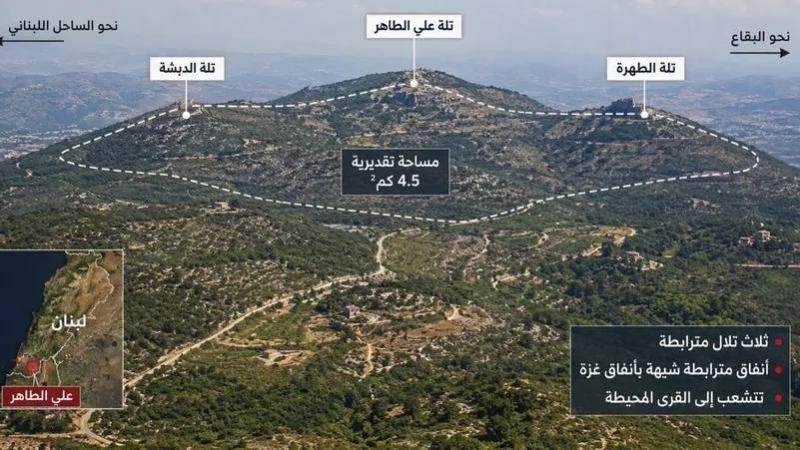
The focus has shifted to the Ali Al-Taher Heights in the Nabatieh district of southern Lebanon, amidst escalating Israeli operations in the region. Reports indicate that Israel aims to establish a new security and geographic reality, granting it military superiority and the ability to exert firepower control over areas extending towards the Bekaa and the Lebanese coast.
Field developments in the south are accelerating, coinciding with ongoing Israeli demolition of residential neighborhoods and bulldozing of houses and lands. Ali Al-Taher Heights and its surroundings are facing repeated airstrikes and bombardments.
Despite the escalation, the map of "experimental areas" does not seem likely to expand in the south, amid Israeli refusal. Meanwhile, Rome is set to host the eighth round of the Lebanese-Israeli negotiations under U.S. auspices on September 1.
Informed sources told "Al-Arabiya" that Lebanese Army Commander Rudolph Heikal plans to visit Rome in the next couple of days, where he is expected to discuss the verification mechanism for the experimental areas, proposing Italy's involvement.
Regarding Ali Al-Taher Heights, diplomatic sources revealed to "Al-Arabiya" that there is no current U.S. green light for Israel to launch a full-scale military operation in the area.
The sources clarified that instead, Israel will continue limited and almost daily military operations, aided by aerial surveillance, aiming to encircle Hezbollah fighters within the Ali Al-Taher facility and prevent them from leaving.
Sources indicated that Hezbollah has communicated through intermediaries its refusal to hand over the Ali Al-Taher facility to the Lebanese army.
Conversely, well-informed sources on Hezbollah's position stated that Israel seeks control of the facility through one of two paths: either through a wide-scale military operation post-U.S. approval, or by encouraging the Lebanese army to take it over, allowing Israel free access for inspection and monitoring inside.
The Lebanese army rejected the idea of taking over the facility and has questioned the President about guarantees preventing Israeli forces from re-entering under the pretext of verifying no military activity exists.
It is confirmed that any broad Israeli operation against the Ali Al-Taher facility would shuffle the deck and change the rules of engagement, with Hezbollah poised to take a defensive stance should Israel proceed with a major attack.
Former Southern Litani Region Commander, Brigadier General Khalil Al-Jamil, ruled out the complete encirclement of Hezbollah fighters within the Ali Al-Taher facility, suggesting their continued ability to move to and from the facility, albeit with difficulty, based on recent security incidents.
Al-Jamil speculated that the facility might serve as a command center for Hezbollah in the south due to its strategic position overlooking Jezzine, Jabal Al-Rihan, and Iqlim Al-Tuffah, close to Nabatieh and positioned at the northern edge of the Litani River.
He suggested that a facility of this size could house at least 100 members for its operation and management.
Al-Jamil noted that evidence collected from large facilities reportedly discovered by the Israeli army indicates that Hezbollah's advanced operational commands in the south were spread across three main sites: the central sector in Bint Jbeil, the eastern sector in Qantara, and the western sector in Majdal Zoun, all of which have been destroyed by Israeli forces.
He explained that the Ali Al-Taher area consists of three interconnected hills: Ali Al-Taher, Al-Dabsha, and Al-Tahra, covering about 4.5 square kilometers with a length of roughly 3 kilometers and a width of up to 1.5 kilometers.
He concluded by noting estimates that the area may contain a network of interconnected tunnels similar to those in the Gaza Strip, stretching across the heights and branching into surrounding villages.