


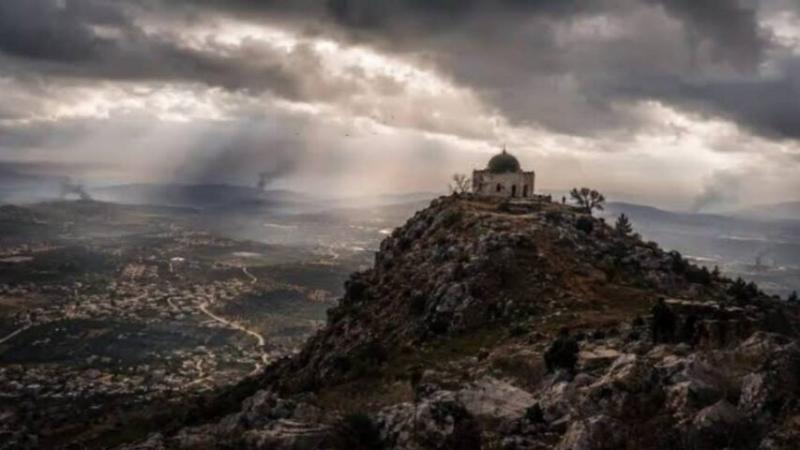
Exclusive information obtained by 'Erm News' reveals the existence of a vast underground military complex belonging to Hezbollah in Northern Bekaa near the Syrian border. This facility is strategically significant and comparable to the one beneath Ali Taher Hill in Southern Lebanon, serving as one of Hezbollah's most crucial military assets, tucked deep in Lebanon away from direct confrontation lines.
A Lebanese security source informed 'Erm News' that the facility is more than just a weapons depot or tactical tunnel network; it is a substantial underground military compound. Its significance has doubled during the current war, especially after extensive damage to Hezbollah’s military infrastructure in the south and Bekaa and reduced access to Syrian supply routes.
The precise location of the facility is undisclosed, but existing reports over the years point to the Hermel region in Northern Bekaa, as evidenced by numerous Israeli and Western reports indicating a deep military infrastructure for Hezbollah, including missile facilities, strategic tunnels, depots, and training sites linked to the Syrian border.
A 2017 Lead
One crucial lead appeared in July 2017, when the French intelligence publication 'Intelligence Online' reported that Iran and Hezbollah were establishing an underground missile plant near Hermel to produce mid-range 'Fateh-110' missiles.
Reports at the time mentioned two underground sites: one in Hermel and another in Southern Lebanon between Sidon and Tyre. The Israeli Alma Center later referenced the facility, stating it was part of an Iranian project to boost Hezbollah's missile manufacturing capabilities within Lebanon.
What makes the Hermel connection more critical today is its enhanced role post-2024 war, becoming a significant node in the remaining military infrastructure of Hezbollah.
Military City Under the Mountains
In October 2024, the Israeli military unveiled a strategic tunnel approximately three kilometers long connecting Northern Hermel to Syrian territory. The tunnel reportedly managed by Unit 4400 transported arms to Hezbollah, with facilities along its sides used for temporary weapons storage arriving via Syria.
A recent July 2026 report by Alma described the extensive tunnel network built by Hezbollah over more than twenty years as a massive project encompassing strategic and tactical tunnels, approach tunnels, and smuggling routes, with investments amounting to billions of dollars.
This implies that talk of a major Bekaa facility refers not to a single tunnel but a complex interconnected network beneath the mountains for storage, command, supply, and possibly parts of the missile system.
Alma also identified the Syrian Qusayr corridor towards Northern Hermel as a long-established key weapons transportation hub, noting Unit 4400's continued operations at the border even after the fall of Bashar al-Assad's regime, attempting to recover weapons and equipment left on the Syrian side.
Not 'Janta'
The source emphasizes distinguishing between the Hermel facility and the known Janta complex near the Syrian border. In November 2024, Israel claimed to have struck a massive underground site in Janta linked to precision missile production, whereas the Hermel site remains a vital military asset for Hezbollah in the current conflict.
This claim is supported by Israel's repeated strikes on the Hermel area. In September 2025, the Israeli military announced executing 12 air raids on military complexes in the region, citing camps for the Radwan Force, weapons depots, and fighter training sites.
Radwan or Unit 4400?
Available information does not indicate that the installation belongs to 'Unit Badr,' operationally tied to the southern front. Although the Radwan Force's presence in Northern Bekaa is documented, suggesting the facility does not belong to them organizationally. The source believes it is a central strategic asset for Hezbollah used by several formations, with Unit 4400 managing aspects of the supply network linked to the border.
This role has become crucial after Hezbollah relocated Radwan elements back south to confront Israeli forces during the current war. Reuters reported in March that unit fighters, who withdrew following the 2024 war, returned to front-line towns like Khiam. Bekaa now functions as a rear reservoir to reconstitute forces and resupply the front rather than merely a rocket storage area.
Ali Taher in the South.. and Hermel in Depth
Lebanese political researcher Ali Hamada told 'Erm News' that the northern facility's significance lies in its functional difference from the Ali Taher facility, explaining that Hezbollah constructed a geographically distributed military system over the years so that the fall of one center does not lead to the collapse of the entire structure.
Hamada argues that Bekaa facilities close to Syria have gained special importance historically tied to the Iranian supply corridor through Syrian territory, providing Hezbollah with a depth far from the southern border, usable for storing weapons, housing military units and centers, and replenishing the front when necessary.
He adds that the current war has placed unprecedented pressure on these facilities, with Syria routes narrowing severely and supply routes and depots facing successive strikes; what's left of the fortified infrastructure under the Bekaa mountains forms an integral part of Hezbollah’s strategic reserve.
This is precisely where the significance of the 'twin' of Ali Taher lies; if the southern facility serves as a forward fortress linked to confronting Israel, the Bekaa facility seemingly functions as a depth fortress protecting Hezbollah's remaining capacity to rebuild and sustain warfare.