


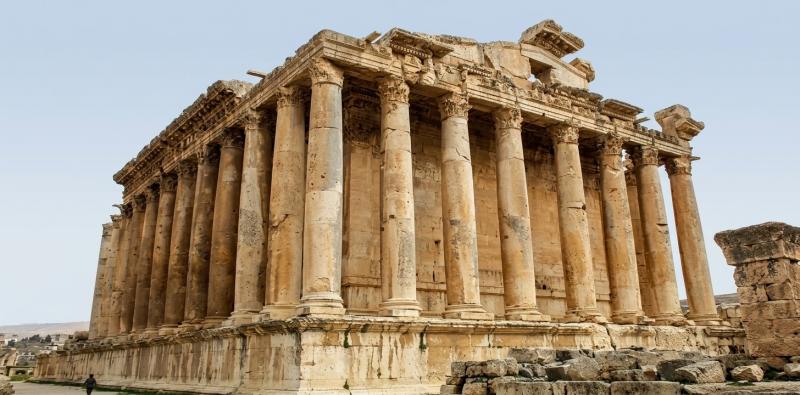
The Temple of Jupiter in Baalbek stands as one of the world’s most captivating archaeological sites. Representing the pinnacle of Roman architecture, it embodies the ancient engineers' ability to execute colossal projects that continue to awe historians and researchers. This temple is located in the city of Baalbek, Lebanon, known in ancient times as "Heliopolis" or the City of the Sun.
Moreover, its importance extends beyond its size to its historical and cultural significance, owing to the succession of different civilizations that imprinted their marks on the site. Thus, the Temple of Jupiter in Baalbek remains a prominent archaeological destination in the Middle East and a significant testament to the grandeur of Roman civilization.
History of the Temple of Jupiter in Baalbek
The Romans began constructing the Temple of Jupiter following their dominance over the region, with construction spanning nearly two centuries. It was designed to be the largest temple dedicated to Jupiter, the chief deity of the Romans, surpassing in size many existing temples in Rome's capital.
Additionally, the Romans chose Baalbek due to its ancient religious status, as it was a center for local deities before their arrival. Hence, the temple was not only an architectural endeavor but also a symbol of the Roman Empire's religious and political power.
Record-Breaking Features That Made the Temple an Architectural Legend
Before diving into the construction details, it’s important to recognize the figures that made the Temple of Jupiter one of history’s greatest engineering feats.
The Largest Known Roman Temple
The Temple of Jupiter in Baalbek is classified as the largest Roman temple dedicated to Jupiter, both in terms of its platform area and the monumental architectural components used in its construction. This grandeur reflected the religious and political status the Romans aimed to bestow upon the city.
The Famous Six Columns
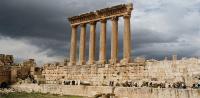
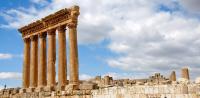
Originally housing 54 massive columns encircling its main structure, many have toppled due to earthquakes and natural factors over centuries. Today, six towering columns remain as Baalbek’s most iconic landmark, each standing about 22 meters tall and over two meters in diameter – akin to a seven-story building. These are among the tallest standing Roman columns globally.
The Giant Trilithon Stones
The curiosity of researchers about the Temple of Jupiter primarily revolves around the "trilithon" stones, three massive boulders forming a part of the temple’s foundations. Each stone is estimated to weigh around 800 tons, sparking ongoing discussions among archaeologists and engineers regarding their transportation, lifting, and precise placement. Despite various scientific hypotheses, the details of this process remain unresolved.
An Architectural Design Melding Different Civilizations
The Temple of Jupiter in Baalbek wasn’t a mere replica of traditional Roman temples but blended architectural and cultural influences that reflected the region’s nature.
The Heliopolis Triad
The Romans exercised a policy of integrating local beliefs with their religion, hence associating the temple with the worship of "Jupiter-Baal," a fusion of the Roman god Jupiter and the Canaanite god Baal.
Furthermore, the design combined classical Roman style with certain Eastern elements, like the vast courtyard used for ceremonies and religious rites.
Exquisite Decorations that Remain Stunning
Despite the passage of centuries, portions of the original decorations remain visible on the column capitals and upper portions of the temple. These decorations feature intricate carvings of mythical animals, plants, and geometric shapes, with certain elements adorned with lion heads serving as rainwater spouts, showcasing the creativity achieved in Roman art.
From Pagan Temple to Defensive Fortress
The story of the Temple of Jupiter didn’t conclude in the Roman era. Rather, it continued to serve various roles as civilizations changed. With the spread of Christianity during the Byzantine era, parts of the temple were dismantled, and a church was constructed within the archaeological complex, a common practice among certain pagan temples at the time.
Furthermore, during the Islamic ages, extensive fortification efforts turned the site into a defensive fortress to protect the city of Baalbek, adding another historical layer to this ancient edifice.
Why Does the Temple of Jupiter Continue to Captivate Scholars?
Researchers are intrigued by the Temple of Jupiter for numerous reasons, including:
- The gigantic stones used in construction compared to the technical capabilities of that era.
- The engineering precision in aligning the columns and foundations.
- The resilience of substantial parts of the temple despite recurrent earthquakes.
- The unique blend of Roman architecture with local architectural traditions.
- Its historical value documenting the site’s evolution through different civilizations.
Has Baalbek Temple Been Listed as a World Heritage Site?
Yes, the Temple of Jupiter is part of the Baalbek archaeological complex, which UNESCO has classified as a World Heritage Site due to its unique historical and archaeological significance. Today, the site ranks as one of Lebanon’s most important tourist and cultural destinations, attracting visitors and researchers worldwide.
Quick Facts About the Temple of Jupiter in Baalbek
- Located within the Baalbek archaeological complex in eastern Lebanon.
- Its construction spanned approximately two centuries.
- Originally housed 54 massive columns.
- Only six columns remain today.
- Each column measures about 22 meters in height.
- Its foundations include the famous trilithon stones, each estimated to weigh around 800 tons.
- The site transitioned through the Roman, Byzantine, and Islamic eras.
- It is one of the world’s prominent Roman archaeological landmarks.
In conclusion, the Temple of Jupiter in Baalbek remains an extraordinary witness to Roman engineering genius and the ability of ancient civilizations to execute massive architectural projects that continue to inspire admiration millenniums later. The towering columns, massive trilithon stones, and intricate decorations provide a comprehensive picture of the flourishing art and architecture of ancient times.
The succession of civilizations added a unique historical and cultural value to the site, making it one of the most significant archaeological treasures in the Middle East and the world.
See Also:
Things to Do in Administrative Beirut: 10 Unmissable Locations and Activities