


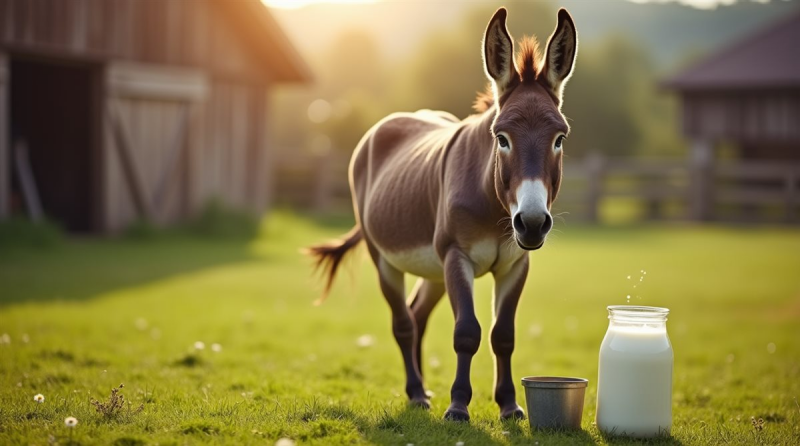
Milk is one of the dietary components that has received particular attention in Islamic jurisprudence, with scholars often correlating its permissibility to the animal from which it is sourced. Hence, the discussion around the permissibility of donkey milk is often tied to the Islamic rulings on consuming and using parts of the animal itself.
With the increasing mention of donkey milk in some countries due to its use in food and cosmetic products, questions about its status in Islamic law have arisen. Significantly, there is a distinction between the domesticated donkey, familiar in everyday use, and the wild donkey, which texts have addressed differently.
What is the Islamic View on Donkey Milk?
The majority of Islamic scholars are of the view that drinking the milk of domesticated donkeys is not permissible. This is based on the prohibition established in Prophetic traditions against consuming their meat.
Scholars refer to hadiths from the Battle of Khaybar, notably those in Sahih Bukhari and Muslim, where the Prophet Muhammad (PBUH) prohibited the meat of domesticated donkeys. Thus, the prevailing opinion is that if the meat of a particular animal is prohibited, its milk is also not considered permissible.
However, discerning between different types of donkeys is crucial and generalized judgments about 'donkey milk' should identify the source animal explicitly.
The Stance of Islamic Schools on Domesticated Donkey Milk
Fuqaha (Islamic jurists) discussed the use of animals forbidden to eat in their texts, generally ruling that their milk follows the same legality as the animal itself.
Hanafi School
Hanafi scholars assert that domesticated donkeys are among the animals whose meat is not allowed for consumption, consequently classifying their milk as non-permissible.
Maliki School
Maliki scholars, discussing the use of animals, connect their stance on donkey milk to the ruling against consuming domesticated donkey meat.
Shafi'i School
Shafi'i scholars also rule that the milk of animals forbidden for meat consumption is non-permissible, hence applying this logic to domesticated donkey milk.
Hanbali School
The Hanbali school, similarly, prohibits drinking domesticated donkey milk based on the prohibition of its meat.
Overall, the consensus among the four major Islamic schools is that consuming domesticated donkey milk is not allowed.
What is the Islamic Evidence for Prohibiting Domesticated Donkey Meat?
The Prophet Muhammad (PBUH) explicitly forbade the meat of domesticated donkeys during the Battle of Khaybar, as evidenced by authentic hadiths recorded in Sahih Bukhari and Muslim. Scholars base their rulings on these texts, distinguishing the domesticated donkey from other animals permitted for consumption and milk extraction.
Difference Between Domesticated and Wild Donkeys
Distinguishing between these types is essential for understanding their respective Islamic rulings:
Domesticated Donkey
Domesticated donkeys are those tamed and historically used by humans for transport and labor, typically found in agricultural and rural settings. Their meat's consumption is expressly forbidden, leading most scholars to prohibit their milk as well.
Wild Donkey
Wild donkeys differ significantly, with Islamic texts suggesting the permissibility of hunting and consuming them, thus differing in legal ruling from their domesticated counterparts.
Is Donkey Milk Forbidden Due to Health Risks?
The ruling on donkey milk does not rely on its health implications but rather on religious texts and jurisprudential rules. Although food may be nutritionally beneficial, this does not inherently grant it religious permissibility, nor does a prohibition necessarily indicate proven health risks.
Can Donkey Milk Be Used in Cosmetics?
Scholars have varying opinions on using animal products prohibited for consumption in other products, such as soaps or creams. This depends on several factors:
- The nature of the substance.
- Processing methods.
- Whether any transformation occurs.
- The intended usage.
These matters often require consultation with a trusted religious authority specific to the country and product circumstances.
Why is There Rising Interest in Donkey Milk?
Attention towards donkey milk has increased due to several reasons:
- Its incorporation into skin-care products.
- Discussions on its nutritional composition similar to human milk.
- Presence of certain nutrients.
- Availability in some European markets.
However, the popularity in specific countries does not change its religious ruling, as it concerns the milk's source and the corresponding animal's ruling.
Also see: Is Cow Milk Healthy? What is Golden Milk? Where is Kefir Milk Sourced From?