


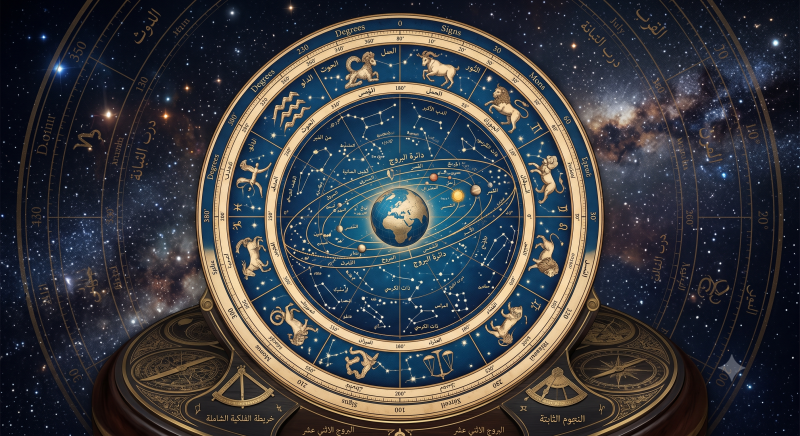
An astrological chart, also known as a birth chart, is a graphical illustration that displays the positions of the sun, moon, and planets across various constellations at a specific moment, usually at a person's birth.
Astrology enthusiasts often use it to analyze personality traits, tendencies, relationships, and career paths according to astrological interpretations.
It's important to note that astrology is different from astronomy. Astronomy is a natural science that studies celestial bodies and their motions scientifically, while astrological interpretations about personality and future events rely on symbolic beliefs unproven by science.
How Is an Astrological Chart Prepared?
Creating an astrological chart typically requires three pieces of information:

Date of Birth
This specifies the day, month, and year of birth, which helps determine the planetary positions at that time.
Time of Birth
Time of birth is crucial, as it helps define the ascendant and astrological houses. Even slight changes in birth time can alter certain astrological readings.
Place of Birth
The birthplace aids in calculating the horizon and dividing astrological houses based on geographical location.
Components of the Astrological Chart
The astrological chart comprises several key elements, each with symbolic significance in astrology.
The Twelve Zodiac Signs
The zodiac circle is divided into 12 signs, with each believed to possess distinct traits and tendencies according to astrology.
Planets in the Astrological Chart
The planets represent different elements in astrological interpretations, notably:
The Sun
Symbolizes general identity and core personality.
The Moon
Associated with emotions and handling of the emotional side.
Mercury
Represents thought processes, communication, and expression.
Venus
Linked to love, relationships, and personal taste.
Mars
Symbolizes energy, drive, and approach to challenges.
Jupiter
Associated with expansion, ambition, and fortune in astrological terms.
Saturn
Represents responsibility, discipline, and challenges.
The Ascendant in the Astrological Chart
The ascendant is a crucial element in the astrological chart, representing the zodiac sign that was rising on the eastern horizon at birth.
Astrology enthusiasts believe the ascendant relates to one's outward appearance and interaction style with the surroundings.
Astrological Houses
The astrological chart divides into 12 houses, each representing specific life areas, such as:
-First House: Personality and appearance.
-Second House: Money and possessions.
-Third House: Communication and learning.
-Fourth House: Family and roots.
-Fifth House: Creativity and hobbies.
-Seventh House: Relationships and partnerships.
-Tenth House: Career and reputation.
Astrological Aspects
Astrological aspects refer to angular relationships between planets within the chart, with astrologers attributing various symbolic meanings to these relations.
Notable aspects include:
-Conjunction.
-Trine.
-Square.
-Opposition.
Distinguishing the Astrological Chart from the Sun Sign
Many people confuse the sun sign with the astrological chart.
The Sun Sign
Refers to the zodiac sign where the sun rests on the date of birth, often seen in daily or monthly horoscopes.
The Astrological Chart
Offers a more detailed view, including the sun, moon, ascendant, planets, houses, and aspects, thus enabling a comprehensive reading in astrology.
Is the Astrological Chart Scientifically Proven?
The interpretations offered by the astrological chart aren't evidenced by scientific methodology. Studies haven't shown a causal link between planetary positions at birth and personality traits or future events.
However, some individuals consider it a tool for personal reflection, exploration, or entertainment.
Why Do People Care About the Astrological Chart?
The astrological chart is popular for various reasons, including:
-Curiosity about personality and traits.
-A desire to understand relationships.
-Interest in astrology and associated cultures.
-Use as a means of entertainment or personal reflection.
See Also:
Famous Theories Proven Wrong by Science
Horoscope Predictions for June 2026: Love, Career, and Money