


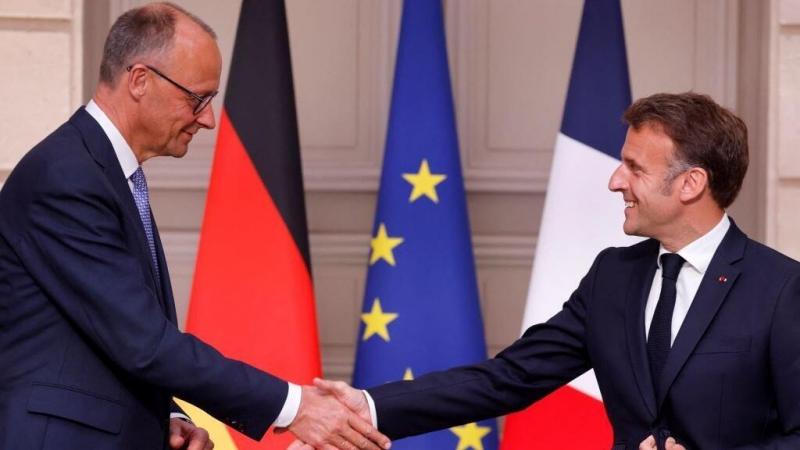
French President Emmanuel Macron is visiting North Rhine-Westphalia, Germany, today, marking a politically and militarily significant trip. German Chancellor Friedrich Merz will welcome him at the "Grand Hotel Schloss Bensberg," setting the stage for a joint Franco-German Cabinet meeting on Friday, which will include ten ministers from both countries.
This visit occurs amidst rising security challenges in Europe, with efforts from France and Germany to strengthen coordination on defense and foreign policy. They are also set to discuss several bilateral issues of mutual interest.
The venue for part of the meetings carries particular significance, as some of the discussions will take place at the German Air Force Base in Nörvenich. This move highlights the growing importance of defense cooperation between Paris and Berlin and underscores the priority of enhancing European military capabilities at this crucial time.
Nörvenich Air Base is a notable German airbase, home to around thirty "Eurofighter" jets and over 900 officers and soldiers. The German authorities have yet to issue an official comment regarding the base hosting this event.
The "Eurofighter," produced by Airbus, is one of Europe's premier multirole combat aircraft and forms the backbone of the German Air Force's fleet, with 138 aircraft in service. Conversely, the French "Rafale" fighter jet continues to maintain its reputation for versatility in executing offensive missions and operating from aircraft carriers, despite competition between the two models.
The Élysée Palace stated that the Franco-German Defense and Security Council meeting is taking place against a backdrop of a shifting geopolitical environment, necessitating accelerated European defense collaboration, coordination on major international issues, and deepening of the military-industrial partnership.
These talks come as joint armament projects between the countries face challenges, notably the stalled "FCAS" future combat aircraft system, one of the principal defense collaboration initiatives between Paris and Berlin.
Macron, who has made the European joint defense project a top priority, continues to advocate for independence in Europe's defense, particularly after the Russian invasion of Ukraine, and amid increasing US pressures on European allies within NATO.
The agenda also includes other topics, such as online protection for minors, combating foreign interference and misinformation campaigns, developing the Franco-German Youth Office, and strengthening cross-border cooperation.
The visit underscores the commitment of Paris and Berlin to expand their strategic partnership, not only in defense but also in economic, social, and technological areas, reinforcing their leadership within the European Union in addressing regional and international challenges.