


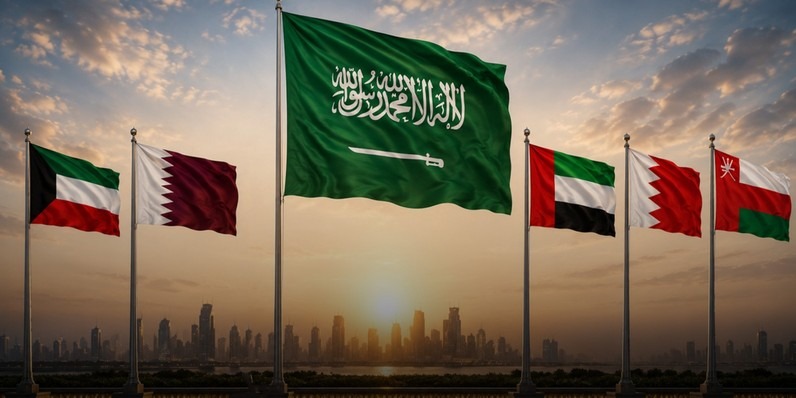
In recent hours, Gulf diplomacy has ramped up joint efforts to address regional and international developments, aiming to bolster stability amid escalating tensions.
The Gulf states have reiterated the importance of safeguarding waterways and keeping the Strait of Hormuz open, following Iranian militia attacks in Iraq against Saudi Arabia that broke a recent calm period. This incident triggered regional and international condemnation due to renewed hostilities.
The level of communication among the Gulf nations rose significantly in recent days, with Foreign Ministers of the region exchanging calls. Discussions focused on "joint coordination to de-escalate tensions and enhance security and stability," especially after the cessation of hostilities between the U.S. and Iran, alongside President Trump's reaffirmation of readiness to undertake "strong military action" if negotiations with Iran falter.
In conjunction with the diplomatic fervor, Gulf armed forces are participating in the joint exercise "Bahrain Shield" from today until Thursday. This exercise aims to strengthen military collaboration among Gulf countries, exchange expertise, and assess joint military systems.
Despite a pause in Iranian attacks against Gulf countries, Iranian-backed Iraqi militias targeted oil facilities in the region’s eastern area and Riyadh, signaling a fragile calm in the region.
Saudi defense forces reported these terrorist attempts originating from Iraqi soil by Iran's affiliated militias, asserting Saudi Arabia’s right to self-defense and retaliation at appropriate times and locations.
Saudi Assurance: Committed to Safeguarding Security and Sovereignty
Saudi Arabia affirmed its commitment to maintaining its security and sovereignty, deterring aggressors, and responding to sources of aggression. The kingdom emphasized Iraq's responsibility to prevent its territory from being used for such aggression.
Subsequently, Saudi Foreign Minister Prince Faisal bin Farhan received phone calls from Qatar's Foreign Minister Sheikh Mohammed bin Abdulrahman and Kuwait's Foreign Minister Sheikh Jarrar Al-Sabah.
The ministers discussed the latest regional developments and ways to enhance and support joint efforts to maintain regional security and stability, condemning Iran and affiliated terrorist militia’s attacks in Yemen and Iraq against the kingdom and the region.
Additionally, Prince Faisal bin Farhan held a call with the UK's Secretary of State for Foreign, Commonwealth and Development Affairs Ed Miliband.
Riyadh-London Talks
The discussions covered bilateral relations, regional events, and collaborative actions to support regional and global security. The British minister expressed a commitment to developing bilateral ties and reiterated solidarity with Saudi Arabia and condemnation of Iran-backed militia attacks in Yemen on the kingdom and the region.
Meanwhile, Saudi Arabia and Oman discussed regional developments, emphasizing the importance of enhancing coordination and consultation to promote joint diplomatic efforts to ensure regional security and free navigation through the Strait of Hormuz.
Kuwait: Defense Agreement with Pakistan
In a notable move, Kuwait approved a defense agreement with Pakistan following an Emiri decree published in the official gazette, regarding defense cooperation ratified in Kuwait on June 11, 2023.
The agreement involves forming a joint military committee for military cooperation coordination. Defense ministers from both countries will head the committee, meeting annually, alternating between Kuwait and Pakistan.
Parallelly, the Kuwaiti Ministry of Defense opened the door for citizens to volunteer for military service in the upcoming Non-commissioned Officers and Individuals Volunteer Course, catering to various educational qualifications.
The ministry outlined conditions for volunteers, extending to holders of university, post-secondary diploma, general secondary, and equivalent certificates, as well as those with eleventh, tenth, ninth, and eighth-grade certificates, according to specified conditions.
Strategic Neutrality: A Deep Wisdom
Conversely, Kuwait's Interior Minister Sheikh Fahad Al-Yousef emphasized that Kuwait's policy of neutrality towards regional conflicts is "a profound strategic wisdom from our political leadership, safeguarding the nation’s security and stability while prioritizing the future of coming generations, reflecting political maturity accumulated over decades of experience."
UAE-Qatar Coordination
In the UAE, Abu Dhabi and Doha intensified political consultations regarding recent regional developments, diplomatic efforts, and joint coordination for de-escalation and security enhancement.
Qatar’s Discussions with Saudi Arabia and Jordan
Qatar expanded discussions with regional countries, notably with Jordan, for diplomatic efforts and coordination to de-escalate and enhance regional security and stability.
Doha emphasized the necessity of dialogue and diplomacy by all parties and implementing the U.S.-Iran memorandum of understanding, including ensuring free navigation through the Strait of Hormuz, to preserve regional security and achievements, enhancing regional stability.
Qatar and Riyadh also discussed diplomatic efforts and coordinated efforts to de-escalate tensions and enhance regional security.
Qatar’s Foreign Minister Sheikh Mohammed bin Abdulrahman and Saudi Foreign Minister Prince Faisal bin Farhan stressed the importance of dialogue and diplomacy by all parties, implementing the U.S.-Iran agreement, and ensuring free navigation through the Strait of Hormuz for regional security and achievements.
Oman’s Discussions with Gulf Nations
Oman enhanced its discussions with Gulf nations while leading talks with Tehran on Hormuz.
Oman's Foreign Minister Badr Al-Busaidi engaged in calls with his regional counterparts, discussing regional updates and efforts to de-escalate tensions.
Maritime Movement Understandings
Oman's foreign minister discussed with counterparts in Saudi Arabia, Qatar, Kuwait, Egypt, and Iran ways to enhance practical, fair, and sustainable understandings for maritime movement and supply chain flow using political and diplomatic solutions serving regional collective interests and all beneficiaires of the Hormuz Strait maritime movement.
Accordingly, Al-Busaidi emphasized to his counterparts the importance of navigation safety and smooth trade and supply chain flows linked to regional and global economies, alongside ongoing coordination and consultation supporting regional security and stability.
Iranian-Omani Negotiations
Muscat and Tehran are negotiating reopening the Strait of Hormuz and associated waterways. Three officials told CBS News that ongoing talks have made significant progress.
Regional Alliance Proposal
CNN sources reported that Oman proposed a regional alliance for services in the Hormuz Strait akin to the Malacca Strait experience, allowing regional cooperation in navigation support and logistics.
Bahraini Joint Exercise
Bahrain will conduct the joint exercise "Bahrain Shield" from today until Thursday, involving Gulf armed forces to strengthen military collaboration, experience exchange, and joint military systems assessment.
The exercise, held amidst a regionally sensitive moment, aims to elevate Gulf combat performance, gain field expertise, enhance joint operations planning, facilitate experience exchange, and unify concepts among participating forces, advancing military cooperation frameworks to address various challenges.