


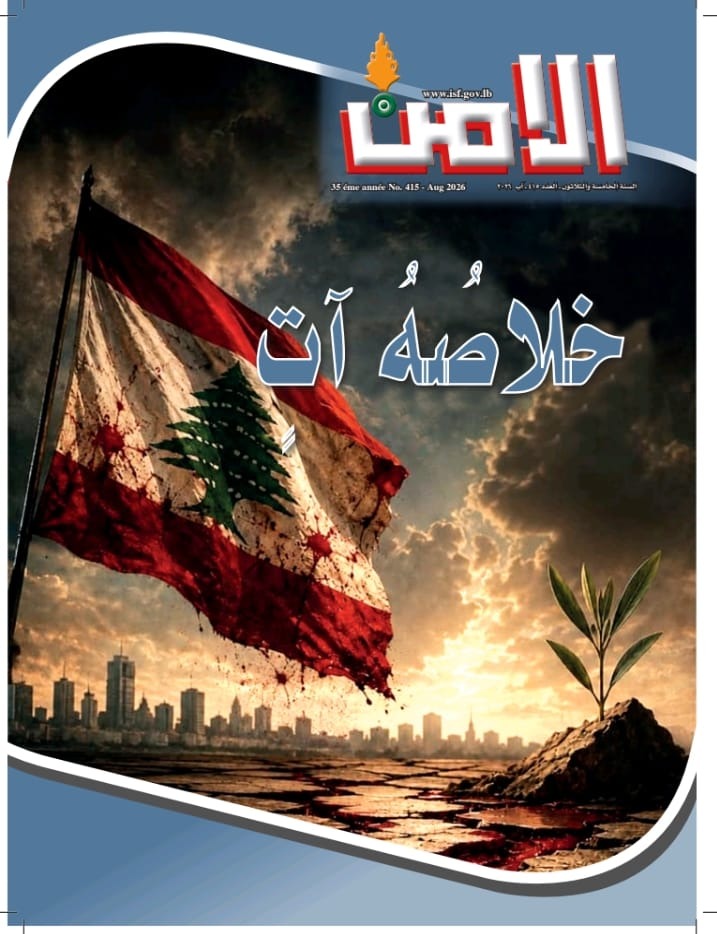
Published under the headline 'Towards Salvation', the latest issue of the 'Security' magazine from the General Directorate of Internal Security Forces features an editorial by Brigadier General Charbel Faram, titled 'Spilled Blood'.
The issue explores the current ambiguous stage characterized by expectations of significant relief, juxtaposed with fears of escalating crises that threaten the nation.
This scenario of anticipation mixed with anxiety is not new, echoing through modern history where joy is often accompanied by sorrow.
Living in acceptance of death and pain seems to have become a norm within the daily details of life.
The danger that looms over society is in reducing human lives to mere numbers on lists of victims or statistical data. People become numbers, as do displaced individuals and destroyed homes, forgetting that behind each digit lie stories, families, and dreams.
Every number represents an entire life; a mother waiting, a father dreaming of his children's future, a child anticipating growth, and a youth planning for a tomorrow that never came. When tragedy is reduced to numbers, we not only lose our capacity to mourn but also a part of our humanity.
What is most perilous for societies is not merely the increase in victim counts but growing accustomed to this rise without holding accountable those responsible for perpetuating a culture of death.
This critical stage in Lebanon's modern history calls for a unifying national discourse.
The true concept of statehood is seen in the single body capable of safeguarding citizens, preserving sovereignty, and upholding the law.
Whenever blood is spilled, a question arises: where do nations go when blood becomes the language of reality, and suicide an alternative to salvation? Spillages impact every facet of the nation.
These lives lost are not just victims of confrontations but symbolize the fragmentation of national decision-making and the subservience of some forces to interests beyond state borders. When particular allegiances and bets override public interest, the nation becomes a ground for settling scores, costing citizens their security, stability, and future.
Nation-building relies not on brute force but on the power of the law and cannot flourish amid illegitimate arms or incendiary rhetoric but through legitimate institutions embracing all citizens, establishing justice, safeguarding rights, and protecting sovereignty. A strong state monopolizes security and political decision-making.
Today, more than ever, there is a pressing need for a comprehensive national project that reinstates the concept of a strong state, as countries thrive on unified will driven by the respect of the constitution and institutions.
The blood shed must mark the final chapter and scene. Protecting the nation begins with safeguarding human life, and valuing life above all else.
The future is possible only with a state capable of bringing its people under one banner, prioritizing national allegiance.