


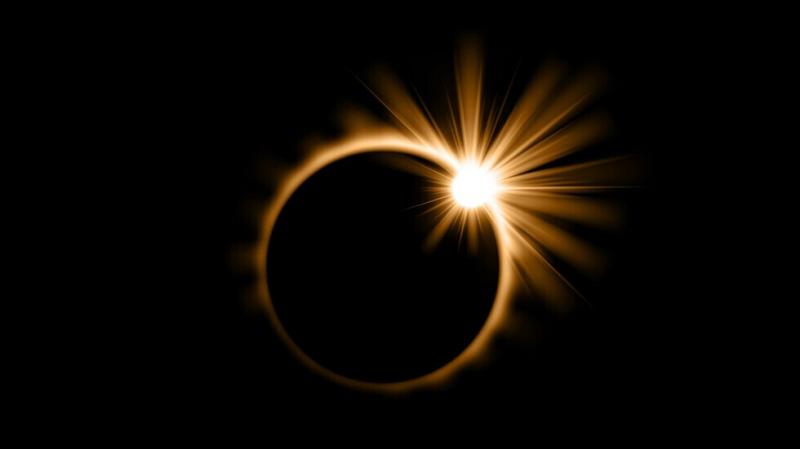
On Wednesday, August 12, millions of people eagerly anticipate a striking astronomical event: a solar eclipse that will be fully visible in certain areas and partially observable across a wider geographic range. Authorities have issued warnings about the risks of directly looking at the sun or using smartphones for photography without proper protective measures.
A solar eclipse occurs when the moon passes between the Earth and the sun, blocking part of the sun's disk during a partial eclipse or covering it entirely in regions within the path of totality.
The total eclipse path stretches through parts of Russia, Greenland, Iceland, and Spain, extending to a small geographical area in the extreme northeastern part of Portugal.
This event holds special significance in Spain, which is set to witness its first total solar eclipse in over a century.
The partial eclipse will be visible to a wider audience, as large portions of Europe, including the UK, Ireland, France, Germany, Italy, Switzerland, and several Balkan countries, will be able to observe it to varying extents.
The phenomenon will also be visible in parts of North Africa, where it can be observed just before sunset in Algeria, Morocco, Tunisia, and Mauritania with significant coverage, while Libya will experience a limited view.
Amid the anticipation, experts have cautioned against pointing smartphone cameras or optical devices directly at the sun, since focused rays can cause the camera sensor to overheat, potentially resulting in permanent damage like faulty pixels.
In a similar vein, NASA had previously warned during the 2024 eclipse against directing phone cameras at the sun and recommended using a dedicated solar filter over the lens when photographing.
The warnings also apply to telescopes, binoculars, and cameras equipped with zoom lenses, as concentrating sunlight through these devices can lead to serious eye injuries.
Special eclipse glasses are essential during the partial phases, while direct viewing of the sun is safe only during the total eclipse, when the moon completely covers the sun's disk. Protective measures should be reapplied as soon as any part of the sun reappears.
Balancing the rare astronomical spectacle with safety advisories for viewing and photography, August 12 promises to be an exceptional occasion for those passionate about celestial phenomena, particularly in the regions on the path of totality.