


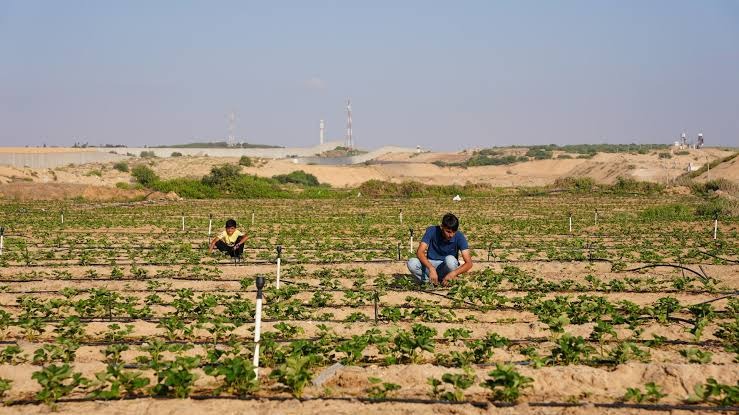
The United Nations issued a warning on Tuesday that only 3% of arable land in the Gaza Strip remains intact and available for farming. This alarming situation is primarily due to expanding military restriction zones.
According to a study published by the Food and Agriculture Organization (FAO) and the United Nations Satellite Centre (UNOSAT), this recent decline is largely due to stringent access restrictions on farmland. This is marked by the westward shift of the "yellow line," which separates areas controlled by Hamas from those under Israeli military jurisdiction.
This new spatial assessment, based on data collected in late June 2026, shows a significant decrease in usable and undamaged farmland, from 601 hectares in October 2025 to just 448 hectares at the end of June 2026—a 25.5% decrease over eight months.
Throughout the entire Gaza Strip, 27% of agricultural land remains theoretically available, though much of it is significantly damaged and requires extensive restoration. Damage has also affected greenhouse facilities, with only 16.6% remaining usable.
The situation is particularly dire in the Rafah area (south), where over 97% of arable land is now inaccessible to farmers.
FAO’s Emergency Response Director, Rein Paulsen, expressed concern over this "critical situation," stating, "Without urgent action to ensure safe access for farmers to their lands and provide necessary support, the chances of recovering local food production will diminish further."
FAO highlighted that farmers and livestock breeders in Gaza face severe shortages of fertilizers, seeds, fuel, and feed, exacerbated by restrictions on border crossings.
Before the outbreak of war in October 2023, the agricultural sector made up about 10% of Gaza's economy and supported over 560,000 people.
The United Nations continually warns of the risk of a complete collapse of food systems in Gaza amid restrictions imposed by the Israeli military.