


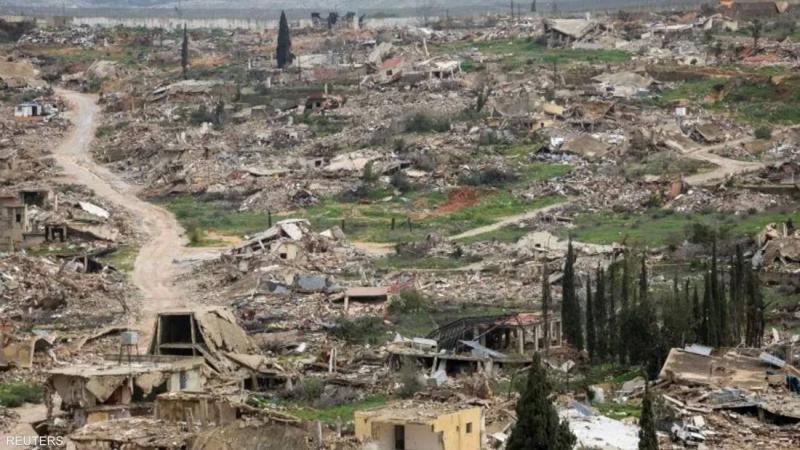
Satellite images and footage indicate that Israeli demolition and bulldozing activities in Southern Lebanon continue despite a decrease in hostilities. These operations have spread to residential areas, roads, civilian structures, and agricultural lands, complicating the return of tens of thousands of residents.
An investigative report conducted by the Financial Times in collaboration with Lighthouse Reports revealed that the destruction extended beyond isolated buildings and expanded gradually from village centers to their outskirts through controlled explosions and the use of heavy machinery.
According to Lebanon's National Council for Scientific Research, approximately 85,000 housing units in the south have been damaged or destroyed. The council suggests the actual number might be higher, as 20 to 30 percent of the buildings have not been assessed due to ongoing operations and difficulty accessing certain areas.
Villages Erased from Maps
The investigation examined satellite images of towns like Khiam, Taybeh, Bint Jbeil, and Hadatha. It concluded that demolition activities affected wide swathes of their municipal boundaries, not just locations Israel identified as linked to Hezbollah.
These findings align with an earlier analysis by Bellingcat, which showed that at least 46 out of 54 towns and villages within the area delineated by Israel as the “Yellow Line” suffered extensive destruction or were largely flattened.
In July, Israeli Defense Minister Yisrael Katz stated that his forces had demolished all buildings in 24 Lebanese villages, estimating the completely destroyed houses to be between 15,000 and 20,000. This figure does not contradict Lebanese estimates, as Katz refers to buildings fully destroyed in specific villages, whereas the National Council's numbers include units destroyed or damaged to varying degrees across the south.
Obstructing Resettlement
The damage extended beyond residences. The investigation revealed the destruction of water and electricity networks, schools, medical centers, roads, and bridges—essential facilities for residents returning even in areas with some remaining homes.
Data from local authorities and the National Council for Scientific Research indicate that at least 2,500 kilometers of water gathering, storage, and transportation infrastructure—including pipelines, wells, and reservoirs—were damaged.
Israel also destroyed bridges over the Litani River, with only two undergoing partial repair.
Images documented the targeting of solar panels used for operating local wells, including a system that powered a water well in the predominantly Christian village of Deir Mimas.
The Lebanese authorities report that about 270,000 people remain unable to return to their homes, in a region comprising 62 villages and farms, covering about 6% of Lebanon's territory.
Agriculture and Heritage
The Lebanese Ministry of Agriculture estimates that more than 20% of agricultural lands and forests in the south have been destroyed, including tens of thousands of olive trees in regions that produce about 40% of Lebanon's olive yield.
Destruction has also reached mosques, libraries, shrines, and archaeological sites, including buildings from the 16th and 19th centuries, as well as Roman ruins and historic forts.
The Ministry of Environment and human rights organizations have documented the use of white phosphorus in populated and agricultural areas. Human Rights Watch stated that using this substance in airbursts over populated areas constitutes a prohibited indiscriminate attack, although Israel claims its legal use for smoke screens and removing vegetation that could serve as cover for military operations.
Israeli Justifications and Legal Concerns
Israel argues that its operations aim to dismantle Hezbollah's infrastructure, prevent its redeployment near the border, and protect northern Israeli populations following Hezbollah's barrage of rockets and shells during the conflict.
Israel claimed that construction equipment might be used to rebuild Hezbollah-affiliated facilities. However, Human Rights Watch reported no evidence of military targets at four sites targeted by Israel in 2025, where over 360 bulldozers and excavators, along with a cement and asphalt factory, were destroyed. They described some attacks as "apparent war crimes."
International law prohibits the destruction of civilian property without specific military necessity and bans collective punishment and forced displacement.
Human rights groups claim that preventing residents from returning through continued occupation and the destruction of homes and infrastructure may suggest forced displacement.
The visual evidence demonstrates that the damage in Southern Lebanon has not been limited to potential military sites, but systematically affected homes, waterways, roads, land, and construction equipment, leaving entire villages without viable conditions for inhabitants to return.