


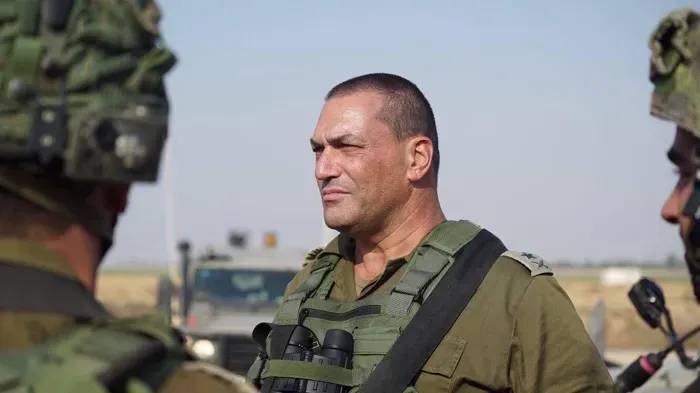
Israeli Chief of Staff Eyal Zamir has reaffirmed that Israel will not permit 'enemy forces' to establish themselves along its borders. He announced that the military has set up an 'advanced defensive posture' acting as a buffer zone in southern Syria. This coincides with ongoing Israeli airstrikes and incursions into Syrian territory, amid increasing regional and international criticism.
Zamir's statements came during an inspection visit to the 210th Division deployed in the area, accompanied by several military officials. He assessed the operational situation and met with reserve soldiers.
In statements carried by Israeli media on Wednesday, Zamir noted that the military operates in a 'multi-front reality,' where the Syrian front is one of these fronts. Israel is monitoring ongoing developments and is prepared to address them.
He added that Israel will not allow enemy forces to station on its borders, emphasizing that the army will use its capabilities 'precisely, at the right place and time.'
Zamir explained that Israel's strategy is to prevent the development of what he described as 'terrorist threats,' while obstructing any significant military threat near the borders, with a buffer zone established as part of an advanced defensive posture.
The Chief of Staff's remarks come amidst escalating tensions regarding Israeli military presence inside Syria, particularly following airstrikes targeting the Abu al-Duhur military airport in eastern Idlib province early Tuesday morning.
Israel defended the airstrikes, accusing Damascus of consenting to Turkish troop deployment at the base, considering such deployments a security threat.
The office of Israeli Prime Minister Benjamin Netanyahu stated that Israel has repeatedly warned Damascus about the consequences of such deployments, accusing Syrian authorities of ignoring those warnings, without explicitly admitting Israeli responsibility for the strikes.
Conversely, Turkey dismissed Israeli claims, labeling them as an attempt to justify the 'illegal' strikes and accused Netanyahu of exploiting the Syrian issue for political and propaganda purposes ahead of Israel's upcoming elections in October.
Damascus condemned the attack on Abu al-Duhur airport as 'unjustified,' calling on the international community and the United Nations to take a firm stand against Israeli operations on Syrian soil.
U.S. envoy Tom Barak also expressed 'grave concern' over the strikes, considering them an unnecessary escalation that might hinder efforts to achieve stability.
The developments coincide with continued Israeli ground movements in southern Syria. A force of more than 100 personnel and about 15 military vehicles invaded the town of Jabatha al-Khashab in northern Quneitra countryside on Wednesday.
The force conducted house raids, arresting two young men before retreating to one of its positions in the area.
Additionally, Israeli forces targeted the Yarmouk basin area in western Daraa with artillery shells on Tuesday. This is part of a series of operations that include incursions, raids, and land bulldozing.
Damascus considers these movements a violation of the disengagement agreement signed in 1974 and demands the complete withdrawal of Israeli forces from Syrian territory.
These developments follow approximately 18 months after the fall of Bashar al-Assad's regime, a period during which Israel carried out hundreds of strikes inside Syria, aiming, as it claims, to prevent advanced military capabilities from reaching entities that might threaten it.
The Israeli army has also expanded its ground deployment, declaring its intent to maintain a demilitarized zone near its borders, amid escalating Syrian and international calls to end the incursions.
The Abu al-Duhur airport, inactive since 2012, is currently protected by the Syrian Defense Ministry. The Syrian Observatory for Human Rights reported that the airstrikes followed a visit by a Turkish military delegation to the site, amid talks about efforts to reactivate it.
With Zamir's declaration of establishing a 'buffer zone,' Israeli accusations about Turkish presence, and the rejection of Israeli military actions by Damascus and Ankara, the Syrian front is heading towards more complexity, as Israeli, Turkish, and Syrian calculations intersect in a rapidly changing military landscape.