


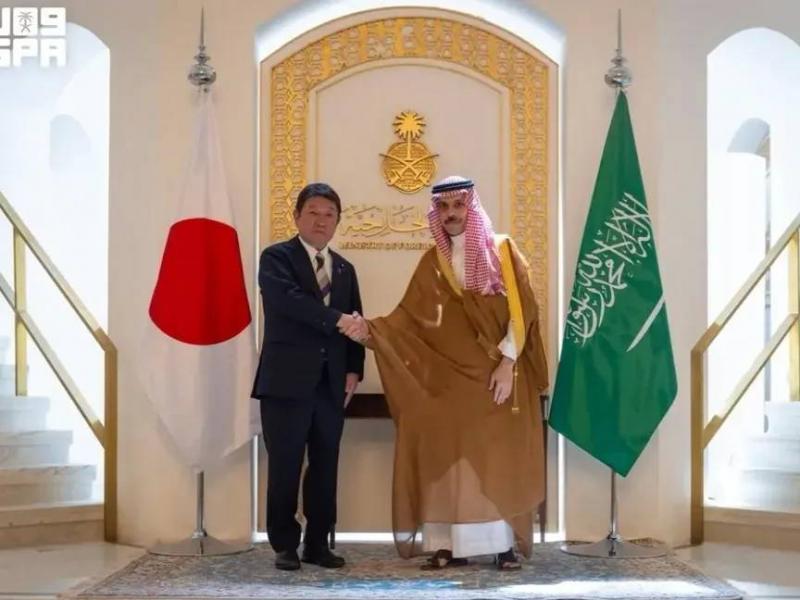
Saudi Foreign Minister Prince Faisal bin Farhan emphasized on Wednesday that diplomacy and dialogue remain at the forefront of the kingdom's priorities in addressing regional crises, while stressing the importance of keeping the Strait of Hormuz, Bab al-Mandab, and other international maritime routes open, safe, and free from threats.
Prince Faisal's remarks came during his reception of Japanese Foreign Minister Toshimitsu Motegi at the Ministry of Foreign Affairs in Riyadh, where the two sides held the third strategic dialogue meeting between Saudi Arabia and Japan.
In his opening speech, the Saudi Foreign Minister highlighted the significant importance of the kingdom's longstanding relations with Japan, which are based on trust and mutual respect, according to the Saudi Press Agency (SPA).
He noted that Japan is a key economic partner for Saudi Arabia and expressed Riyadh's eagerness to continue developing bilateral relations and leveraging available economic and investment opportunities between the two countries.
Prince Faisal outlined promising opportunities to expand cooperation in investment, energy, resources, supply chains, as well as in defense, technology, and expertise exchange and capacity building.
He stated that developing the partnership in these sectors would support Saudi and Japanese priorities and help achieve their mutual goals amidst rapid economic and security changes regionally and internationally.
The Saudi Foreign Minister affirmed that the kingdom remains a reliable partner for Japan in various fields, particularly in energy, commending Tokyo's efforts and initiatives aimed at enhancing economic resilience and supporting the stability of global energy and trade markets.
The maritime security issue held a prominent place in the discussions, with Prince Faisal describing it as a shared priority for Riyadh and Tokyo, emphasizing the need to protect freedom of navigation in international waterways according to international law.
He stressed the importance of keeping the Strait of Hormuz, Bab al-Mandab, and other maritime passages open and safe from any threats amid increasing regional tensions affecting navigation, energy markets, and global trade.
Regarding regional crises, Prince Faisal stated that Saudi Arabia continues its efforts to de-escalate tensions and prevent renewed conflicts, pushing for comprehensive and sustainable diplomatic solutions addressing sources of instability in the region.
He reiterated that "Diplomacy, dialogue, and peaceful means remain our priorities," underscoring Riyadh's commitment to a political course to resolve crises and prevent the expansion of regional confrontations.
The Saudi Foreign Minister also praised Japan's role in supporting the principles of international law, alongside its humanitarian and developmental contributions and its positions supporting stability and peaceful resolutions.
The Riyadh-Tokyo talks gain additional importance amid the disruptions affecting trade and energy routes, particularly in the Strait of Hormuz and Bab al-Mandab, making navigation security and energy market stability a shared interest for both countries.
The third strategic dialogue reflects a tendency to expand Saudi-Japanese relations beyond the traditional energy partnership to include defense, technology, investment, and supply chains, alongside enhanced political coordination on regional crises.
Amid calls to keep maritime routes open and commitment to peaceful solutions, Prince Faisal bin Farhan's statements reflect Riyadh's efforts to balance protecting economic interests and energy security with addressing regional escalation through diplomacy.