


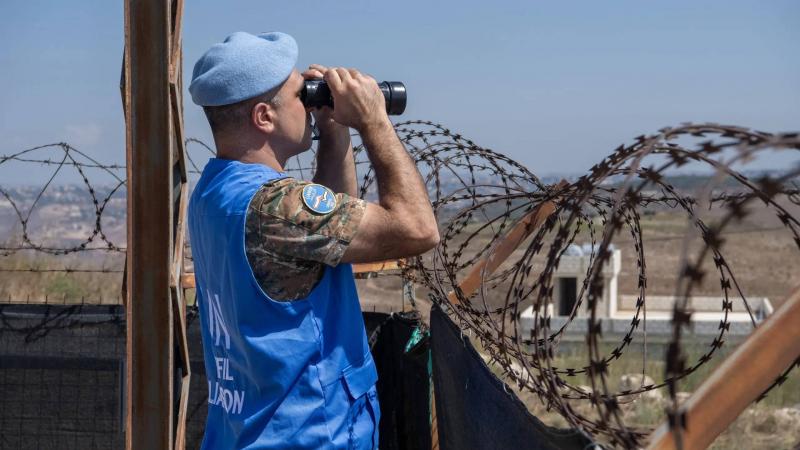
The United Nations Interim Force in Lebanon (UNIFIL) has emphasized the indispensable role of its liaison branch in facilitating de-escalation efforts. This role is crucial not only in search and rescue missions and the passage of humanitarian aid convoys but also in repairing essential civilian infrastructure and facilitating the movements and operations of UNIFIL and the Lebanese Army in southern Lebanon.
UNIFIL highlighted the increased importance of this role during periods of rising tensions, as demonstrated following recent escalations, where the branch works to keep communication and coordination channels open between various stakeholders on the ground.
Colonel Thomas Laboosh, head of the branch, stated that his team, consisting of 20 officers from different nationalities, acts as a 'bridge' that facilitates fieldwork amidst significant challenges and complexities.
The team includes experienced officers and translators, whose expertise and humanitarian qualities enable them to undertake extremely difficult tasks. Laboosh noted, "This operation has proven effective; regardless of whether the situation in southern Lebanon deteriorates or calms, field communication remains constant."
Highlighting the importance of de-escalation, he added, "As long as there are different actors not operating on the same chessboard, we need someone to connect them." However, he acknowledged the complex nature of these missions: "Of course, we cannot de-escalate in every situation because de-escalation is not an exact science."
De-escalation is a crucial activity in the tense operational environment of southern Lebanon, relying on communication and coordination with the Lebanese and Israeli armies to support the safe movement of peacekeepers, humanitarian workers, and sometimes civilians, through information exchange to avoid misunderstandings and minimize security risks.
The liaison branch maintains continuous communication with the Lebanese and Israeli armies and various humanitarian organizations operating in southern Lebanon, alongside UNIFIL leadership and relevant components within the international force.
This constant communication is supplemented by a permanent and visible field presence on both sides of the Blue Line through field patrols conducted by the branch.
The branch processes and addresses dozens of de-escalation requests and notifications daily, being the only unit in the mission with an actual presence on both sides of the Blue Line.
Even during the peak of recent hostilities, when most of UNIFIL's field operations on the Lebanese side of the Blue Line were suspended, liaison branch patrols continued in northern Israel, south of the Blue Line.
Though the liaison branch was officially established in December 2006 following the summer conflict of that year, de-escalation efforts began in 1986 through a small team formed to communicate and coordinate with multiple actors.
Flexibility is a key characteristic of the liaison team, as pointed out by Laboosh, who emphasized that success is not always guaranteed, and planning is conducted on this basis to ensure smooth operations and support UNIFIL's mandate.
Laboosh described the branch as a "highly flexible tool," primarily available to the UNIFIL Head of Mission and Force Commander but ultimately benefiting a much broader range of stakeholders.
He explained that "flexibility means our ability to adapt to the situation, which may be affected by changing behaviors of different actors, directives from leaders, or major events like armed tensions escalating in certain areas," highlighting that various factors might influence their work.
UNIFIL asserts the importance of the liaison branch in its ability to maintain coordination between various parties regardless of circumstances, acting as a link explaining what should be done, what can be done, and how to implement it.
While liaison officers dedicate their efforts to achieving de-escalation, this does not necessarily guarantee how understandings are applied on the ground, necessitating the deployment of teams to event sites to communicate with various parties, resolve misunderstandings, and facilitate task execution.
Laboosh noted, "When we face on-ground frictions for various reasons, the liaison branch can send a patrol including members tasked to explain the purpose of any activity, and clarify or remind its framework, meaning there are mutual agreements to get things done on the ground."
He emphasized that neutrality is essential for building trust, which in turn is crucial for establishing and strengthening long-term professional relationships, asserting that these relationships prove invaluable in resolving issues and calming situations.
With UNIFIL's mandate ending on December 31, and the subsequent downsizing and withdrawal of forces, the de-escalation role of the liaison branch will continue for some time.
Laboosh predicted that the continuation of this role will add direct value to the de-escalation process, with UNIFIL's movements expected to increase during the troop reduction and withdrawal phase.
He added, "With UNIFIL's withdrawal, all movements will increase, and the security conditions during the withdrawal will be crucial to ensure everything proceeds safely without any injuries or fatalities in any incidents, hence de-escalation remains necessary until the mission's end."