


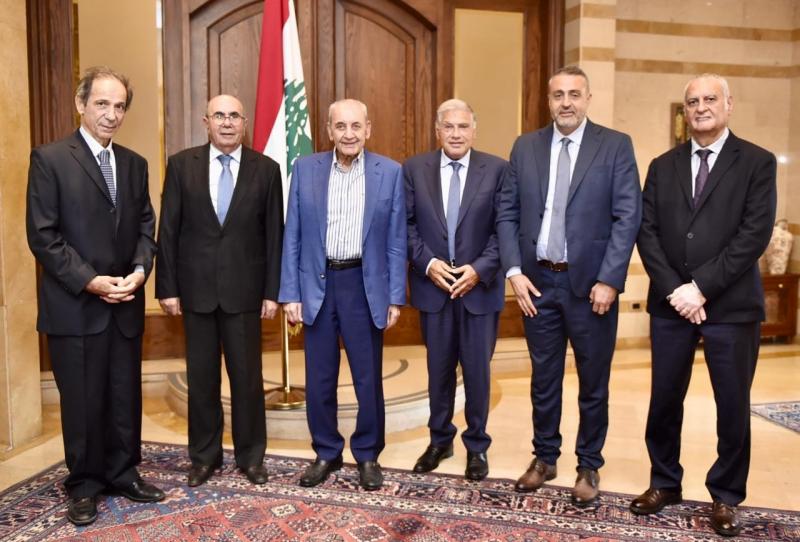
The Speaker of the Lebanese Parliament, Nabih Berri, received Nassif Seqlawi, the Chairman and General Director of the Lebanese Tobacco and Tumbac Monopoly Administration 'Regie', along with a delegation of board members, at the second presidency headquarters in Ain al-Tineh. Seqlawi presented Berri with Regie's work programs and the institution's preparations to receive the crops, as well as the repercussions of the Israeli aggression on the tobacco farming sector and the sacrifices and hardships faced by the farmers.
After the meeting, Seqlawi said: "We are honored to visit Speaker Nabih Berri, especially as we are about to receive obtainable tobacco crops from the farmers. We came to seek guidance and listen to the directions of the Speaker, who has always been and continues to be the primary supporter and patron of the tobacco farmers' community."
He added: "We are facing a tragedy that has affected the farmers. The Israeli aggression has caused thousands of farmers to flee their villages and towns such as Aita al-Shaab, Aytaroun, Meiss al-Jabal, Toul, Sawaneh, Hadatha, Kfartibnite, Sarifa, and many other villages, which are agricultural strongholds. More than 80% of the crops weren't planted, and the rest is limited cases, including Remish, which was planted despite the blockade. Today, there was a meeting with the army to coordinate crop reception. Despite the aggression in the Bekaa, farmers managed to plant their crops, and we expect an almost complete season. The same is expected for Akkar, where we will also have a full season."
Seqlawi continued: "I wish to acknowledge the heroic resilience of the farmers and their attachment to their land, like the farmer Ali Fadl Al-Dheib from the village of Shuhur, who was martyred while working in his field during the harvest. There are now 38 martyr farmers of tobacco. Based on our national and social responsibility and the directives of the Speaker, we will do everything we can to assist those who planted and those who did not. I would like to highlight some instances of steadfastness in the face of aggression, as in the cases of Breiqaa, Ras Al-Ain, Deir Ammas, Bourj el-Shemali, and Babliyeh, where individuals planted even under bombardment over their heads."
Also, Speaker Berri followed up on general situations, especially health, hospitalization conditions, the Ministry of Health's work programs, and political and field developments during his meeting with the Minister of Health, Rakan Nasser Al-Din.