


Economy and Trade Minister Amer Bassat emphasized that Lebanon’s economic recovery is closely tied to implementing serious reforms, asserting decision-making authority over war and peace must lie solely with the state.
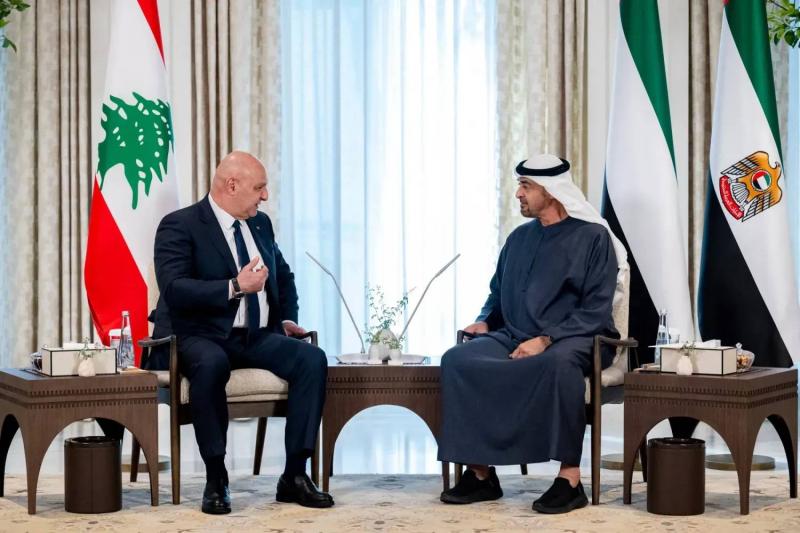
Bassat's remarks came during a Lebanese-UAE forum held in Beirut aimed at boosting economic cooperation. Strategic memorandums of understanding were signed, attended by Lebanese Prime Minister Nawaf Salam, UAE Minister of Foreign Trade Dr. Thani bin Ahmed Al-Zeyoudi, alongside several ministers and representatives of economic bodies, chambers of commerce and industry, and the Lebanese-UAE business councils.
‘Your Presence is a Message of Confidence’
Bassat noted that Lebanon is undergoing a critical phase, exacerbated by ongoing war and accumulated economic and financial crises. He regarded the UAE delegation's visit to Beirut under these circumstances as exceptionally signalizing.
He stated that Lebanon needs the confidence of its friends more than ever, seeing the UAE’s presence as a clear message to Lebanese citizens, investors, and the private sector that “Lebanon has not been written off.”
He affirmed that Lebanon-UAE relations are not new but rooted in longstanding economic and humanitarian ties, underscoring the need to build upon and deepen this relationship.
Reform and Sovereignty are Key to Recovery
Bassat highlighted Lebanon’s main strengths, including a dynamic private sector, skilled workforce, and extensive connections with regional and global markets. He emphasized these capabilities could be turned into real investment opportunities, even though the crisis has not diminished them.
He stressed, however, that potential alone is insufficient; true recovery requires genuine reforms across various sectors such as economy, banking, finance, and essential services, along with governmental operations.
The minister linked attracting investments and establishing trust with political and security stability, asserting that state sovereignty, monopoly over weapons, and the decisions of war and peace must solely be managed by the state, as no economy can thrive without a stable environment and clear sovereign decisions.
Special Economic Partnership Between Lebanon and UAE
Discussing the role of the private sector, Bassat believed the economic recovery should be a private sector-led initiative, drawing inspiration from UAE’s success in creating a conducive business and investment environment and being open to capital, talents, and global markets.
He pointed out the already strong ties between the business communities of both countries, mentioning how many Lebanese companies and talents have established their presence in the UAE, creating a favorable ground for new partnerships.
In this context, he called for exploring a special economic partnership framework between Lebanon and the UAE to increase trade and investments, transfer knowledge and expertise, and connect companies and markets in both countries.
Additionally, he quoted UAE Minister Dr. Thani bin Ahmed Al-Zeyoudi, highlighting that the UAE signed 38 agreements with various countries over the past five years, pointing out Lebanon’s delay in this arena and the need to open up to new economic and trade pathways.
UAE Confidence Amidst Challenges
Bassat concluded by affirming that Lebanon possesses potential beyond its current economic reality. Transforming this potential into actual growth requires reform and sovereignty, with the private sector as the primary recovery driver and the UAE as a key partner in this journey.
While acknowledging the significant challenges Lebanon faces, he emphasized that there are valid reasons to act, reiterating that “Lebanon has not been written off”, with the main challenge today being to restore confidence and make the country once again a worthwhile destination for investment and capital.