


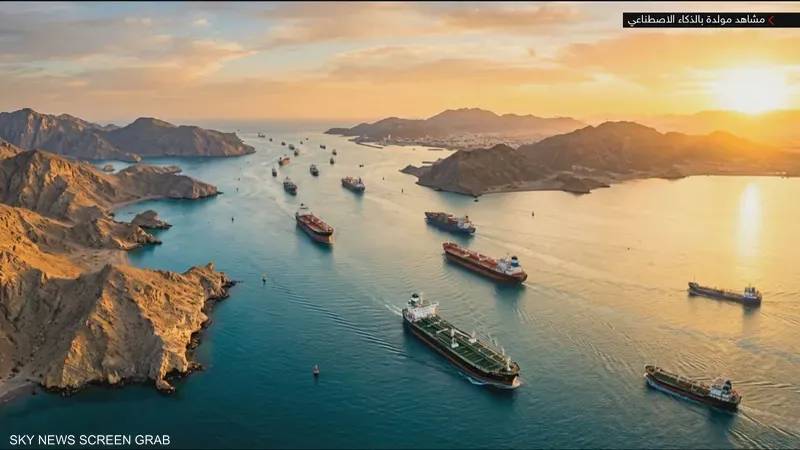
The clock is no longer Tehran's ally in its mutual blockade battle with the United States. The Iranian regime, which gambled on closing the Strait of Hormuz and prolonging the conflict to increase costs for Washington, now faces a steep decline in oil exports, a rapidly collapsing currency, and sharply rising food prices, all while Iranians bear the daily cost of a seemingly endless power struggle.
According to a report by the "Wall Street Journal," the U.S. reinstated its naval embargo on Iranian ports in July after a brief understanding between the two sides collapsed. Since then, Iran has been unable to ship its oil, the report says.
Data from "TankerTrackers" reveals an imbalance in the calculations Tehran had made. Over a 28-day period, approximately 5 million barrels of oil passed through the strait daily, almost none of which was Iranian, while an additional 2.5 million barrels exited via ports on the Gulf of Oman.
As a result, more than 40% of regional oil flows recorded before the conflict continued, and global crude prices remained below $100 per barrel, contrary to expectations that closing Hormuz would lead to an energy crisis crippling the global economy.
This aligns with a Reuters report indicating that Iranian oil exports have plummeted from about 1.7 million barrels per day to roughly 260,000, delivering a direct blow to Tehran's main source of hard currency.
Moreover, circumventing sanctions has become costlier and more challenging, as Washington tightens its pursuit of institutions and parties that continue financial dealings with Iran.
Yet, the heavier loss doesn't show up on maritime maps but in Iranian markets and homes. Official annual inflation hit 66% in July, with food prices skyrocketing 128% year-on-year, according to Iranian Statistical Center data reported by Reuters.
The rial has plummeted to over two million rials per dollar, and President Masoud Bazghian acknowledged that exports and imports have fallen by about 35% due to sanctions and the blockade.
Europe Joins Trump's Iran Stance
Iranian officials, as cited by the "Wall Street Journal," had estimated that the country could endure the blockade for about five months before severe economic repercussions emerge. As that deadline approaches, indicators reveal a narrowing margin for maneuver: oil revenues are depleting, the currency is losing value, importing becomes more complicated, and losses immediately impact basic goods prices.
These figures mean Iranian households are paying the political bet's price through their ability to buy food, pay rent, and maintain their jobs. With reduced revenues and import finance difficulties, the risks of fuel shortages and rising transportation and production costs grow, amid reports of families forced to cut basic needs or seek additional work.
Despite this pressure, the Iranian leadership does not appear ready to make concessions to end the confrontation.
Iranian-American researcher Vali Nasr believes Tehran is caught between two harsh choices: accepting terms it views as surrender or military escalation to improve negotiation conditions. The approaching U.S. midterm elections might tempt the regime to prolong the conflict to weaken President Donald Trump politically, but every additional month doubles the burden on Iran's domestic scene.
Thus, the Strait of Hormuz, intended by the regime as a pressure tool against its adversaries, becomes a burden that backfires on its people. The longer Tehran prolongs the standoff without a political exit, the more its resources dwindle and the inflation circle widens, leaving Iranians paying the bill for a war they neither chose nor have the power to end.