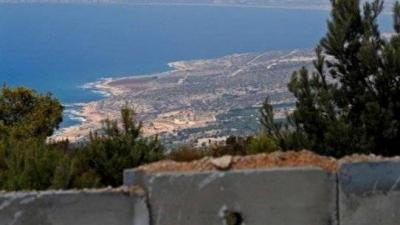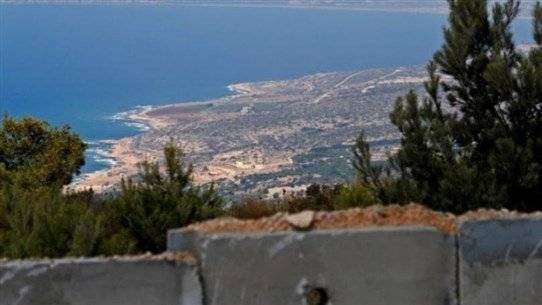
A Lebanese official source closely linked to the atmosphere of discussions led by the U.S. mediator Amos Hochstein regarding the maritime border demarcation between Lebanon and Israel revealed that there is a possibility to resume indirect negotiations between the two countries in Naqoura under U.N. supervision and U.S. mediation, provided that Hochstein convinces Israel to extend line 23 southward to affirm Lebanon's right at land point B-1 located at the head of Naqoura Bay.
The same Lebanese official source told "Asharq Al-Awsat" that the opportunity will be open not only for resuming indirect negotiations but also for signing the initial agreement regarding the maritime border demarcation if Lebanon receives confirmation from Hochstein this week that Israel has agreed to Lebanon’s request to extend maritime line 23 southward to secure Lebanon’s rights at land point B-1, especially since it is located within Lebanese territory and was established in the 1923 border demarcation and later reaffirmed in the second border demarcation in 1949, after Israel occupied most of Palestine and established its state.
The source confirmed that Hochstein has made progress in his talks with state officials, but nothing is definitive until Israel agrees to retreat on land beyond point B-1. He noted that Speaker Nabih Berri did not engage with him in demarcating the lines and insisted on the necessity of returning to the framework agreement to resume indirect negotiations for maritime border demarcation, mediated by the U.S. and under the auspices of the U.N.
The official pointed out that one positive aspect Hochstein brought to Beirut is that Israel is not inclined to postpone the agreement should it be reached, past the early elections in Israel. He expressed astonishment at claims made by the political team associated with President Michel Aoun that Berri and caretaker Prime Minister Najib Mikati do not want to finalize the border demarcation agreement before the presidential term ends on October 31, insinuating they are delaying it so that the achievement in oil and gas exploration is not credited to Aoun. He stated that such accusations are part of incitement against the heads of Parliament and the government, especially since the Parliament has approved all regulatory and procedural decrees to initiate exploration and allow Lebanon to benefit from its marine resources.
The source added that Berri and Mikati are not responsible for delaying the agreement's completion, and that the responsibility lies with the political team related to Aoun, which has been characterized by confusion and hesitation, attempting to use maritime border demarcation as a bargaining chip for lifting U.S. sanctions imposed on Jibran Basil, a member of the "Free Patriotic Movement." This was discussed with former U.S. Assistant Secretary of State for Middle Eastern Affairs David Hale, who referred the presidential team to the U.S. Treasury as the sanctions originate from there, despite the same team attempting to amend decree 1433 under the assumption that withdrawing it from circulation should coincide with lifting sanctions.
The U.S. mediator has communicated that he will not intervene in land border demarcation, informing the three presidents that his mission is limited to the maritime aspect. This is something that Major General Abbas Ibrahim noted, emphasizing that there is no overlap at all between land and maritime demarcation. He stressed that raising the issue of land point B-1 is essential to affirm Lebanon's right of ownership and end Israel's occupation of it, considering Israel’s security concerns due to its direct proximity to several Israeli settlements along the coastline.
The same source concluded that there is potential for signing the border demarcation agreement within two weeks, contingent on the U.S. mediator informing the Lebanese side that Israel has approved its request to reclaim Lebanese land. He stated that returning to Naqoura depends on Hochstein's success in his mission, and then Israel's extraction of oil could coincide with Lebanon starting its oil and gas exploration in Lebanese waters.
In this context, the Lebanese source revealed that the U.S. mediator informed the Lebanese side that he received assurances from the French that Total is prepared to commence oil exploration in Lebanese waters immediately following the signing of the maritime border demarcation agreement. Notably, it was reported on a television channel from a source close to Hezbollah that Hochstein has made progress regarding Lebanon’s requests about maritime line 23 and the full Kana field.
He emphasized that the success of the U.S. mediator in his mission in Israel would lead to the consolidation of ideas in preparation for drafting the initial agreement, which would be presented to both Lebanese and Israeli sides to transition to the practical aspect of resuming indirect negotiations in Naqoura, paving the way for the final signing of the agreement. Thus, it is crucial to acknowledge Hezbollah’s positive approach through Al-Manar TV towards the U.S. mediator's mission for the first time, opening the door for Major General Ibrahim’s endeavor to communicate with him to update him on the prevailing atmosphere during his talks in Beirut.
Although Major General Ibrahim's contact with Hezbollah remains under strict secrecy, several unofficial Lebanese sources closely following Hochstein's mission in Beirut are questioning whether the party is considering reducing its aggressive posture by escalating threats towards Israel after it has been convinced that its drone missions over the Karish field pressured Israel to engage positively in the indirect negotiations for border demarcation. Alternatively, the source speculates whether the party has indirectly responded to a U.S. request to ease pressures to allow for safe mediation after U.S. President Joe Biden decided to intervene directly in the negotiations to provide conditions for their continuation, away from exchanges of fiery messages between the party and Tel Aviv, despite the fact that Hezbollah’s Deputy Secretary-General Sheikh Naim Qassem has ruled out war, stating that Israel is currently in a very difficult situation internally and in terms of war preparedness.