


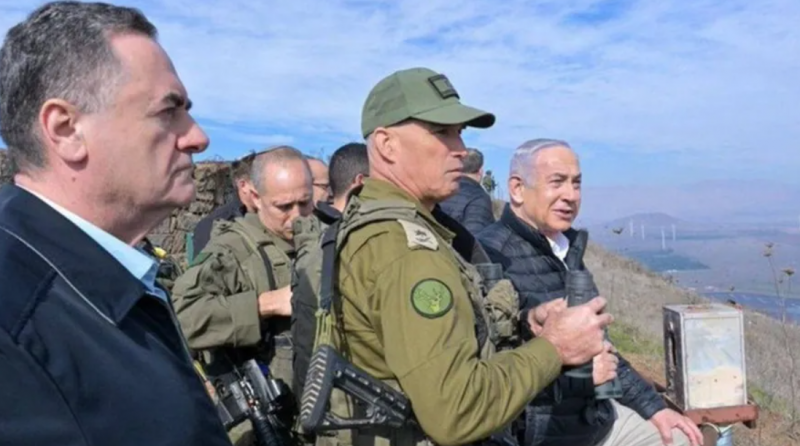
The Hebrew newspaper “Yedioth Ahronoth” has reported that Israeli Prime Minister Benjamin Netanyahu convened a limited security meeting to discuss developments in Syria and Lebanon. This follows expressed concerns over potential Syrian military movements.
According to the newspaper, while Tel Aviv rejects any Syrian military deployment inside Lebanese territory, there are fears Damascus might be preparing practical steps in this regard. Details of the meeting or its agenda remain undisclosed.
These developments arose following comments by U.S. President Donald Trump at the G7 Summit, suggesting Syria could be tasked with dealing with Hezbollah.
In an interview with Fox News, Trump remarked that “Israel is prolonging its fight with Hezbollah more than necessary,” noting that “too many people have been killed.”
He further called the Lebanon front a “small war” compared to Iran, portraying Syrian President Ahmed Sharaf as favorably disposed against Hezbollah. If Israel cannot accomplish its mission without massive casualties, Trump suggested Syria might be able to.
Damascus's Position and Reaction
Despite Syrian President Ahmed Sharaf’s denial of any intention to intervene militarily in Lebanon and his emphasis on playing a supportive role in finding a “calm resolution,” Trump's remarks have sparked widespread debate within Israel.
Reports also indicate that Sharaf expressed willingness to engage in dialogue with Hezbollah, complicating the regional situation for Israeli policymakers.
Israeli media analyses reveal two main lines of thought within its political and security establishments:
The first, security-strategic in nature, warns that any Syrian involvement in Lebanon might lead to “new regional chaos,” opening the door to extensive sectarian clashes or providing Turkey, via its influence in Damascus, “a foothold on Israel’s northern border.”
The second perspective sees the U.S. suggestion as either a failure of Israeli diplomacy in handling the northern front or a sign of Washington’s waning patience with prolonged conflicts.
Concerns Over Northern Front Reshaping
In a report by “Israel Hayom,” an Israeli source highlighted concerns about possible spillover of any confrontation into the Israeli-occupied territories, suggesting a need to “contain any such intervention.”
Haaretz analyst Zvi Barel notes a growing divide between U.S. and Israeli positions on Lebanon, suggesting Washington might use Damascus to try reorganizing the regional landscape, even as Syrian leaders recognize the risks military engagement poses to their domestic stability.
Contradiction in U.S. Policy
In an analysis by Channel 12, Karmit Valensi argues that the U.S. potentially encouraging Sharaf to act against Hezbollah reveals a contradiction in American policy, aiming to stabilize a new Syria while coaxing it into military adventures beyond its borders.
These ideas have surfaced before, such as the March talks of possible Syrian troop movements in eastern Lebanon, which Damascus shelved fearing escalation into wider regional conflict.
According to Channel 12’s Dana Weiss, Israeli security views this scenario as “the worst possible outcome,” warning that its realization could present a new regional reality involving Turkish and Syrian influence on its northern frontier.
She added that the best Israeli response to this scenario lies not in public opposition but in swiftly aligning with Lebanon and bolstering the southern Lebanese army's role.