


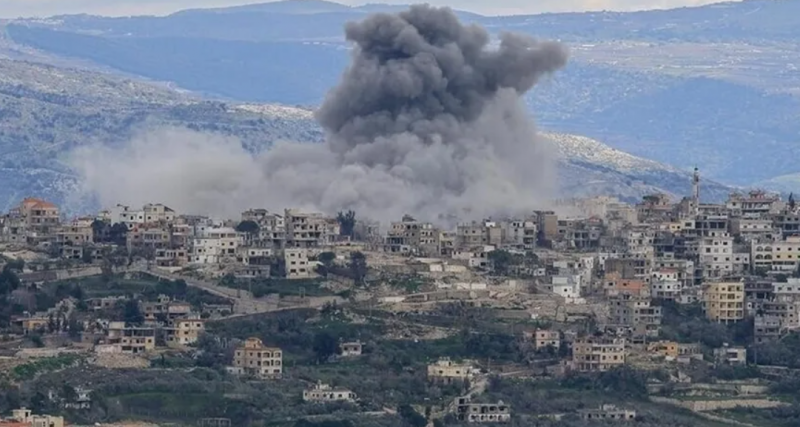
An Israeli assessment suggests the potential failure of the recently announced trilateral agreement between Lebanon, the United States, and Israel, which is based on a "performance for withdrawal" principle. The agreement assumes that the Lebanese government can disarm Hezbollah, a feat it has yet to achieve.
After four days of intensive negotiations at the U.S. Department of State in Washington, Lebanon, the United States, and Israel signed a framework agreement purportedly "paving the way for future peace and security agreements between the sides."
Performance for Withdrawal
According to Hebrew site "Walla"'s political correspondent Idan Kofler, the deal represents one of the most ambitious political moves on the northern front in years. It involves establishing a new American mechanism and creating trial zones from which the Israeli army will gradually withdraw, while the Lebanese army assumes security responsibilities and concurrently disarms Hezbollah.
However, moments after the deal was signed, Lebanese MP from Hezbollah, Hassan Fadlallah, stated that the party "will not allow the Lebanese authorities to implement the agreement unless the state decides to ignite a civil war," affirming that "Hezbollah will oppose any disarmament attempts and will hold on to its weapons even more strongly."
Walla noted that this highlights the considerable gap between the celebratory statements issued in Washington and the existing reality in southern Lebanon, a gap well understood by Israel.
Following the signing, a senior Israeli political official emphasized, "Israel will remain within the security belt as long as Hezbollah and other armed groups in Lebanon are not disarmed and the threat to Israel persists." He reaffirmed that "the Israeli army will maintain full operational freedom within the security belt, and any withdrawal will follow a model based on practical achievements rather than fixed timelines."
Walla highlighted that "this represents one of the agreement's key elements. For years, arrangements regarding Lebanon were measured by preset timetables; this time, Israel insisted on reversing the equation—withdrawal is only after actual disarmament of Hezbollah, followed by a gradual pullout."
According to the understandings, the Israeli army will withdraw from these trial areas: one south of the Litani River outside the Blue Line and the other north of Litani, with the Lebanese army demonstrating its ability to control and prevent Hezbollah's return to these areas and exert full sovereignty. The site noted that "if this model proves successful, it will be expanded to include additional areas."
The Real Test
Israeli Ambassador to the United States, Yehiel Leiter, explained that "the agreement is performance-based," claiming that "the faster areas are removed from Hezbollah's influence, our withdrawal pace is set; Iran is out of the equation, and Hezbollah is on its way out, with the Lebanese army on its way in."
This phrase "performance-based," noted Walla, captures the essence of the agreement. Unlike the memorandum of understanding signed between Washington and Tehran, the three countries have attempted to separate the Lebanese arena from Iranian influence this time.
Israeli Prime Minister Benjamin Netanyahu, under corruption allegations and accused of war crimes in Gaza, stated that "the agreement deals a severe blow to Iran, which tried to impose an Israeli unilateral withdrawal from southern Lebanon, but Israel, Lebanon, and the United States responded: You have no role in Lebanon, neither you, Hezbollah, nor any group."
U.S. Secretary of State Marco Rubio commented, "The first step is often the hardest, but also the most important," claiming the agreement aims "to enable residents on both sides to enjoy a future of peace, prosperity, and coexistence."
Walla pointed out a key paradox: "The U.S., Israel, and Lebanon signed a document entirely based on the assumption that the Lebanese government will achieve what it never has—disarming Hezbollah."
The distance between Washington's statements and the reality in southern Lebanon villages remains vast, with thousands of rockets, a wide underground infrastructure, and a military force not under Lebanese state authority, plus longstanding Iranian support. For these reasons, the agreement signed in Washington serves as merely the start of a political journey."
Walla concluded, "The success of the agreement will not be measured by the signing ceremony led by Rubio, nor by Netanyahu or Joseph Aoun's statements, but on the day Lebanese army enters the first village in southern Lebanon, removes Hezbollah elements, and Hezbollah chooses not to respond." They highlighted, "Everyone in Washington knows signing the agreement was the easy part; the real test begins now."