


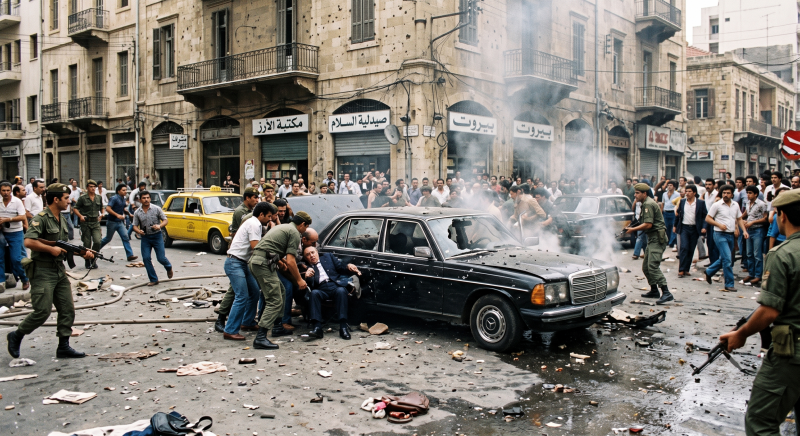
Lebanon's modern history is marked by a long series of political assassinations targeting presidents, prime ministers, ministers, parliament members, journalists, and party leaders.
These assassinations occurred amidst Lebanon's complex scene, interwoven with regional and international conflicts, making the country a stage for pivotal events that left deep political and security impacts.
Key Political Assassinations in Lebanon:
Assassination of Riyad Al-Solh (1951)
Riyad Al-Solh was Lebanon's first Prime Minister after independence and among the earliest political figures to be assassinated in modern Lebanese history. He was killed in Amman, Jordan, on July 16, 1951, during an official visit, shocking the region due to his role in establishing an independent Lebanese state.
Assassination of Kamal Jumblatt (1977)
On March 16, 1977, Kamal Jumblatt, a political leader and founder of the Progressive Socialist Party, was assassinated in the Chouf area after his convoy was ambushed. His assassination is considered a major event in the Lebanese civil war due to his significant political and popular weight.
Assassination of Tony Frangieh (1978)
Minister and former deputy Tony Frangieh was killed, along with several family members, in what is known as the "Ehden Massacre" on June 13, 1978, one of the deadliest events of the Lebanese civil war.
Assassination of Bachir Gemayel (1982)
Elected Lebanese President Bachir Gemayel was assassinated on September 14, 1982, after a bombing targeted the Phalange Party headquarters in Ashrafieh, shortly before he was to officially take office. His assassination significantly affected events in Lebanon at the time.
Assassination of Rashid Karami (1987)
On June 1, 1987, Prime Minister Rashid Karami was killed after a bomb exploded inside a military helicopter taking him from Tripoli to Beirut.
Assassination of Hassan Khaled (1989)
Grand Mufti Hassan Khaled was assassinated on May 16, 1989, in a car bomb explosion in Beirut. He was known for advocating national dialogue and ending the civil war.
Assassination of Rene Mouawad (1989)
Seventeen days after his election as president, Rene Mouawad was assassinated on November 22, 1989, in a bombing in Beirut following Independence Day celebrations, marking a new political phase.
Assassination of Rafic Hariri (2005)
The assassination of former Prime Minister Rafic Hariri on February 14, 2005, is one of the most impactful in Lebanon's modern history. The massive explosion that targeted his convoy in Beirut killed Hariri and several escorts, leading to significant political upheavals in Lebanon and the region.
Assassination of Samir Kassir (2005)
On June 2, 2005, journalist and writer Samir Kassir was assassinated by a bomb planted in his car in East Beirut. He was known for his influential political writings on Lebanese affairs.
Assassination of George Hawi (2005)
A few weeks after Samir Kassir's assassination, former Lebanese Communist Party Secretary-General George Hawi was killed on June 21, 2005, in a car bomb explosion in Beirut.
Assassination of Gebran Tueni (2005)
Journalist and parliamentarian Gebran Tueni was assassinated on December 12, 2005, by a car bomb in the Mkalles area east of Beirut. He was a prominent media and political figure at the time.
Conclusion
Political assassinations have been a painful part of Lebanon's modern history, targeting figures with crucial roles in political, media, and religious life. Despite differing circumstances and suspects in each case, these events left profound impacts on Lebanon's landscape, with many cases still under discussion and investigation.
See Also: