


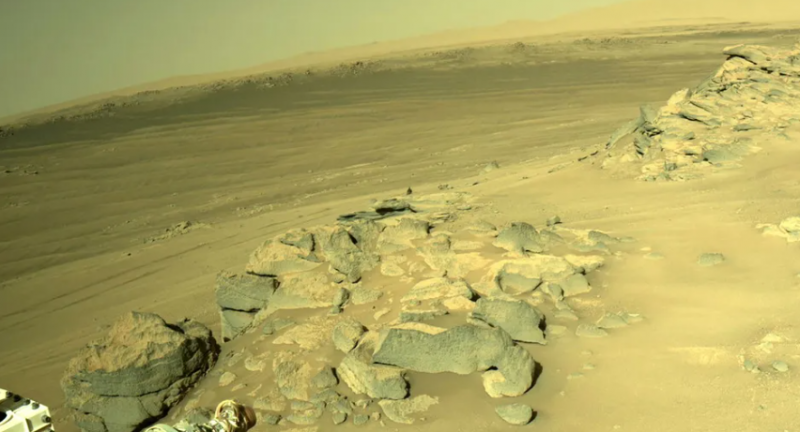
Scientists are gaining deeper insights into the nature of certain organic carbon discovered on Mars' surface, thanks to the 'Perseverance' rover, as they explore whether this planet ever hosted life.
Organic carbon is the molecular foundation of all known living organisms.
A new study describes the structure of the organic carbon found by NASA's rover last year in sedimentary rocks that may contain a "biosignature," or a potential sign of past microbial life.
These clay rocks might have formed between 3.2 and 3.8 billion years ago under a now-vanished water body in Mars' Jezero Crater.
The organic carbon can serve as evidence to determine whether Mars once supported life since it forms the chemical basis of the molecules that make up DNA, cells, and proteins.
However, its presence is not definitive proof of life, as it can also arise from non-biological processes like chemical reactions between rocks and water.
The discovery of organic carbon was announced in two rocks named (Chʰiavav Falls) and (Walhala Glades) in Jezero Crater last year when researchers suggested a potential biosignature in one.
Planetary scientist Ashley Murphy, from the Planetary Science Institute in Arizona and one of the new study's leaders published in Science Advances, said the rover sampled rocks from sites about 100 meters apart.
Following last year's discovery, NASA released an image of the 'Chʰiavav Falls' rock, showing a fine-grained clay stone with a rust-like red hue, ring shapes resembling jaguar spots, and dark marks akin to poppy seeds.
Such features on Earth can be linked to microbial activity.
A potential biosignature, or "biomarker," is a substance or structure with a possible biological origin, but further data or studies are needed before concluding the presence or absence of life.
Using the SHERLOC instrument on the 'Perseverance' rover, researchers conducted a detailed study of the complex carbon, known as macromolecular carbon, in the rocks.
Researchers noted that this carbon resembles carbon formed through biological or non-biological processes on Earth and carbon from non-biological processes found in meteorites.
This marks the first discovery of macromolecular carbon in clay rocks within Jezero Crater, where the 'Perseverance' rover landed in 2021.
Another NASA rover, 'Curiosity,' previously found macromolecular carbon in a different location, Gale Crater, about 3,700 kilometers from Jezero.
Kyle Ockert, a planetary scientist at NASA's Jet Propulsion Laboratory in California and one of the study contributors, stated that this discovery bolsters the evidence that Mars once contained chemical components and environmental conditions that could support life, but it does not prove the existence of life itself, nor does it clarify whether the carbon's origin is organic or inorganic.
The rover instruments cannot determine if this carbon originated from biological processes, possibly involving microbial activity.
Ockert emphasized that "we need to return these samples to Earth for more precise tests using more sensitive and accurate instruments."