


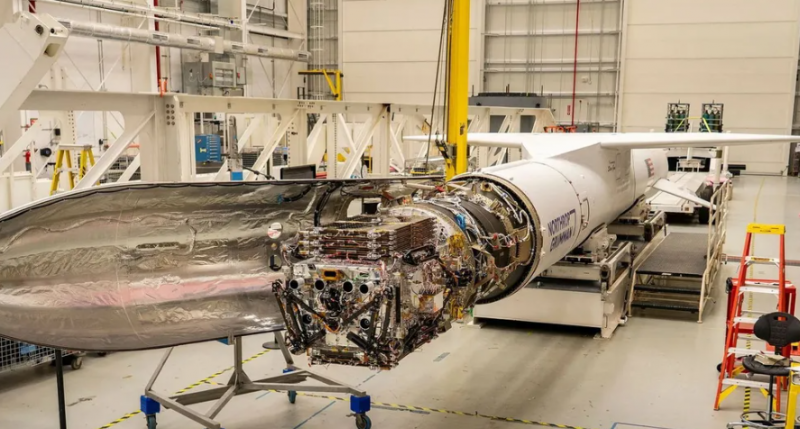
NASA embarked on an unprecedented mission last Friday to send a robot into Earth's orbit in a daring attempt to save the aging 'Swift' telescope from plummeting and burning up in the atmosphere.
This ambitious $30 million mission aims to grant the gradually descending telescope a new lease on life, allowing it to continue its observations of some of the universe's most violent phenomena.
The spacecraft 'Link', developed by Catalyst Space Technologies, launched from the Marshall Islands in the Pacific Ocean aboard a small Pegasus rocket, which itself was deployed from a modified aircraft.
The journey of 'Link' is expected to take about a month to reach an orbit near the 'Swift' telescope. Following this, it will perform a series of intricate maneuvers to locate, orbit, and then attach to the telescope using three robotic arms.
Upon successful docking, the robot will attempt to slowly propel the telescope to a higher orbit to avoid vibrations that could damage its sensitive equipment, a process estimated to take at least a month.
Currently, the 1.6-ton 'Swift' is orbiting at approximately 360 kilometers above Earth. The mission aims to elevate it by 240 to 300 kilometers, returning it close to its original orbital position.
Costing around $250 million, the telescope is employed to study gamma-ray bursts, some of the most powerful explosions known in the universe, as well as supernovae and other astronomical phenomena.
Sean Domagal-Goldman, NASA's Astrophysics Division Director, noted the mission involves "many firsts," expressing gratitude, saying, "I am incredibly thankful just for embarking on this mission."
If successful, 'Swift' could resume its cosmic observations by September, potentially opening the door to extend the operational life of other satellites and telescopes.
Among future candidates for a similar mission is the Hubble Space Telescope, which is also experiencing a gradual decrease in its orbit's altitude.
NASA is racing against time to save 'Swift', as the agency anticipates that without orbital elevation, the telescope could fall and burn in the atmosphere by October.