


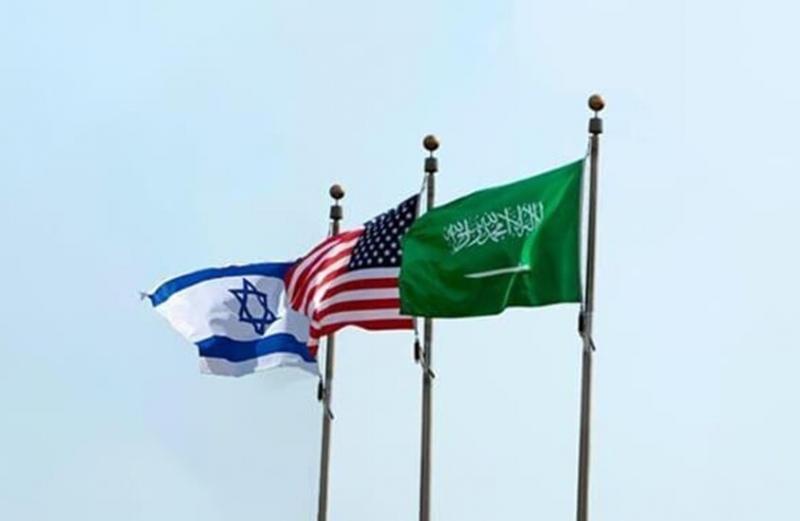
Israeli journalist and political analyst Nadav Eyal argued that Prime Minister Benjamin Netanyahu's government missed a historic chance to reach a normalization agreement with Saudi Arabia, leading, in his opinion, to a decline in Israel's role in reshaping the Middle Eastern landscape.
In an article published by "Yedioth Ahronoth," Eyal states that the region is moving towards new economic and strategic arrangements while Israel is left out of the "Peace Corridor" (IMEC) project, aimed at connecting India and the Gulf States to Europe through a network of ports, railways, and modern infrastructure.
He explained that former U.S. President Joe Biden's administration proposed the project in 2023 to enhance regional cooperation and push for Israel-Saudi Arabia normalization. Riyadh had expressed its willingness to invest billions of dollars in it, but the outbreak of war in Gaza stalled this path.
According to Eyal, Saudi Arabia showed readiness in 2024 to proceed with a normalization agreement even amid the war, envisioning a permanent ceasefire, a prisoner exchange deal, and assigning another party to manage the Gaza Strip, alongside an Israeli commitment to a path leading to a Palestinian state within five to seven years.
He added that Saudi Crown Prince Mohammed bin Salman informed the U.S. administration of the kingdom's willingness to participate in managing the Gaza Strip under post-war arrangements, aiming to end the conflict and create conducive conditions for normalizing relations.
The article pointed out that Washington was concurrently working on a package of strategic understandings with Saudi Arabia, seeking political support within Israel to ensure Netanyahu's government's continuity amid potential internal opposition to the agreement. However, Netanyahu, according to Eyal, refused to proceed, believing the required concessions did not match the expected benefits, instead betting on achieving a decisive military victory in Gaza.
The writer believes this gamble resulted in the loss of a significant political opportunity, as Saudi Arabia later focused on its relations with President Donald Trump's administration while maintaining the necessity for a clear path towards a two-state solution before joining the Abraham Accords.
Eyal concluded by saying that Israel has become more isolated both regionally and internationally, while the countries in the region continue to shape a new Middle East, with Riyadh advancing its strategic interests independently of a normalization agreement with Israel.
This analysis is based on an article by the writer in an Israeli newspaper, reflecting his perspective on the normalization process and the political decisions made by the Israeli government during that period.