


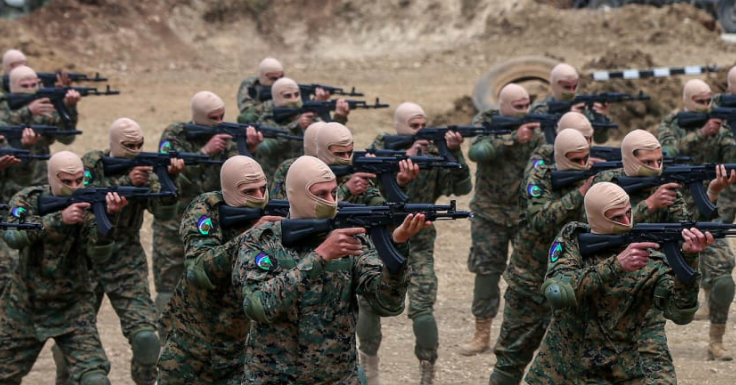
An Israeli report reveals that despite military and financial setbacks experienced during its conflict with Israel, Hezbollah has successfully reinstated much of its financial capabilities through an intricate international network. This network spans from Lebanon to the Middle East, Africa, Latin America, and even into the digital realm, relying on gold, cryptocurrencies, front companies, and smuggling operations to circumvent international sanctions.
The study, authored by Dr. Yiftach Borbman and published by the Foundation for Defense of Democracies (FDD), highlights that while Iran spent over four decades building Hezbollah as a military power to confront Israel, Israeli military operations significantly damaged its leadership, arsenal, and manpower. Nevertheless, the group is rebuilding by leveraging illicit global financing networks.
The report notes that Hezbollah suffered a severe financial blow after the targeting of Al-Qard Al-Hassan Foundation, sanctioned by the U.S. Treasury since 2007, restricting access to critical funds and gold reserves. Additionally, heightened international sanctions and a maritime blockade on Iranian ports in April 2026 have hindered Iran's ability to finance Hezbollah, leading to near-paralysis of Iran's oil-export economies.
Despite these challenges, the report asserts Hezbollah has shown remarkable adaptability, raising over $1 billion since early 2025, mainly from the Iranian Revolutionary Guard, to fund its operations and rebuild its military. These insights are corroborated by open sources and Western intelligence.
In Lebanon, Hezbollah formed the company 'Jood SARL' in September 2025 to bypass sanctions on Al-Qard Al-Hassan via a declared gold trading business, which was later sanctioned by the U.S. Treasury. Hundreds of millions from Iranian oil sales were funneled through money exchangers and transfer companies in Lebanon.
The report adds that Captagon trafficking remains a crucial income stream even after the fall of Bashar al-Assad's regime, with its production relocated to Hezbollah-controlled areas in Bekaa and Southern Beirut. A Lebanese-Iraqi network allegedly rerouted over $100 million intended for Iraq's reconstruction between 2020 and early 2026, laundering it through shell companies in Poland and Slovenia to fund Hezbollah’s military acquisitions.
Furthermore, Kuwait and the UAE uncovered networks linked to Hezbollah financing, arresting 24 people in Kuwait—including five former MPs—and sanctioning Lebanese institutions. The UAE dismantled a parallel network smuggling gold and funds for Hezbollah and Iran. Turkey has become a pivotal hub for funneling hundreds of millions from Iranian oil and gold trades back to Lebanon, facilitating military equipment purchases.
In Africa, the report identifies West Africa as a key financing center, with Shiite communities involved in diamond trades and consumer goods. Shell companies in Ivory Coast also facilitate continued reliance on diamond trade, commodity smuggling, and the 'hawala' system for moving funds between Africa and Lebanon.
In Latin America, Hezbollah continues laundering money and smuggling oil, coal, drugs, diamonds, and counterfeit currencies. However, the arrest of Venezuelan President Nicolás Maduro disrupted a significant financial base reliant on Venezuelan gold and Iranian oil for arms purchases. Nevertheless, financial networks utilizing trade and remittances persist.
The report also highlights China and Russia's roles in the financial network. Profits from Iranian energy trade with China are routed through shell companies in Hong Kong, the UAE, and Turkey to Lebanon, with Russian intermediaries converting revenues to advanced military equipment and technology.
In the digital realm, 2025 marked a turning point with increased Hezbollah dependence on cryptocurrencies. Iran facilitated about $1 billion in cryptocurrency transfers since early 2025, while transactions linked to the Iranian Revolutionary Guard, including Hezbollah, exceeded $3 billion through digital wallets and platforms using Tether (USDT) to finance Iranian oil trade, money transfers, and military equipment purchases.
The report concludes that Hezbollah's ability to adapt to sanctions using shell companies, digital currencies, global trade, and Shiite networks in Africa and Latin America offers an opportunity to rebuild. The report calls for strengthening international intelligence cooperation, asset seizures, pursuit of shell companies, and reinforced border, financial, and cryptocurrency sector monitoring, emphasizing that the ultimate goal of these networks is not economic gain, but to finance Hezbollah’s rearmament and military activities.