


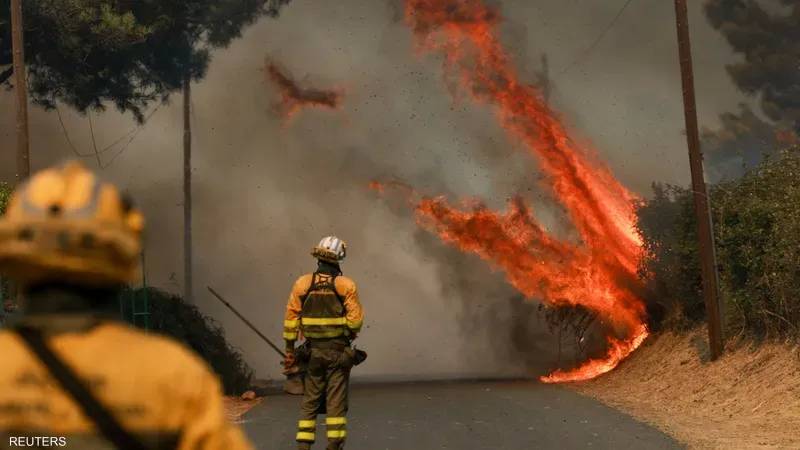
Wildfires advanced on the outskirts of Bordeaux, France, on Sunday, threatening its historic vine-laden regions as France and Spain battle blazes that have displaced hundreds of thousands.
Authorities evacuated around 220,000 people in France and over 75,000 in Spain, with 30,000 instructed to shelter in place.
In France, flames ravaged the Cap Ferret Peninsula, a popular Atlantic coast destination, and spread near Bordeaux, where firefighters are working to prevent the fires from reaching the city center.
Bordeaux Mayor Thomas Caseneuve indicated: "The fire is about 15 kilometers from the main city entrances."
French Interior Minister Laurent Nunez told France 2 TV late Sunday: "We have an uncontrolled fire moving towards the city. It's an unprecedentedly dangerous situation."
Earlier, Caseneuve noted no immediate plans to evacuate Bordeaux's 850,000 residents; however, Nunez assured continued assessment of the situation.
Police began evacuating residents of Marcheprime and Cestas as the fire expanded, with authorities releasing footage of officers urging residents to leave in the night.
In Spain, Prime Minister Pedro Sanchez visited fire-hit Avila, one of three central provinces affected alongside Madrid and Toledo.
Spanish Environment Minister Sara Aghisin reported over 50,000 hectares consumed in Avila, marking the largest wildfire in modern Spanish history.
Numerous blazes burned in Spain as officials reported a separate fire in Castellón destroyed over 4,300 hectares.
Valencia local government head Florentino Perez commented: "The fire is out of control, and its technical suppression is challenging due to adverse weather expected throughout the day."
The fire encroached on Sierra de Espadán Natural Park, home to extensive pine and oak forests.
These blazes are the latest linked to prolonged drought and heat waves, intensified by climate change according to scientists.
Reuters climate monitoring indicated Bordeaux and Avila's July max temperatures averaged 32°C — about six degrees higher compared to 1961-1990 norms.
International assistance arrived as EU Civil Protection Mechanism saw Greece and Italy send firefighting aircraft to Spain, while Portugal deployed over 100 personnel alongside equipment.
Spain's Interior Ministry announced on "X" platform two additional aircraft from Turkey will arrive "as soon as possible."
Sanchez said the government will declare an emergency in affected central regions Tuesday, enabling extra funding for reconstruction.
Spain has seen over 150,000 hectares burned since January, six times the area destroyed in the same period last year.
Fires also raged in Scotland and Italy as up to 500 firefighters fought a massive blaze in Scotland's Cairngorms National Park since July 15.
Residents of Nethy Bridge returned home Saturday after Friday evacuations due to changing weather.
In Italy, forest fires closed a southern section of Rome's ring road and a highway leading to the capital, causing significant traffic disruption.
The National Fire Service evacuated tourists from coastal resorts in Puglia's Gargano area due to a major fire, with Italian news agency Ansa stating some were transported by sea by the Coast Guard.
Pope Leo expressed support for firefighting efforts from his summer residence at Castel Gandolfo near Rome.
Pope Francis stated: "Amid the devastating wildfires in parts of France and Spain, I extend solidarity and pray for those affected and rescue teams involved in relief efforts."