


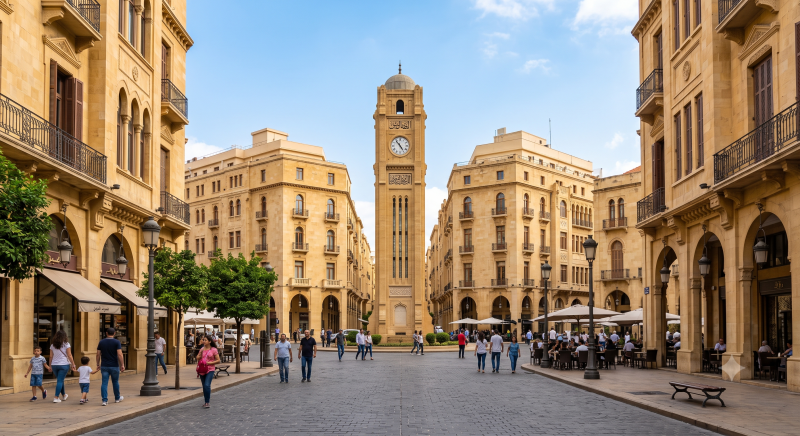
Nejmeh Square, or Place de l'Étoile, stands as the historical heart of downtown Beirut, redesigned during the French Mandate in the 1920s to serve as an administrative, political, and cultural hub for the capital. Its radial layout, from which streets diverge in all directions, continues to lend a unique architectural character to the area.
Beyond its strategic location, the square is surrounded by historical buildings reflecting the evolution of Lebanese architecture throughout the 20th century, blending classic European style with local elements that define central Beirut's structures.
Iconic Historical Buildings in Nejmeh Square
Clock Tower of Abed
The Clock Tower of Abed stands at the heart of the square as its most photographed landmark. Built in the 1930s, its stone facade and four-faced clock have become symbols of downtown Beirut. This tower was a gift from Lebanese-Brazilian businessman Michel Abed and remains a central meeting point in the square.
Lebanese Parliament Building
The Lebanese Parliament Building is the most prominent structure surrounding Nejmeh Square, serving as the political core of Lebanon. Completed in 1934 by Lebanese architect Mardiros Altounian, it merges classical European architecture with traditional Lebanese features like triple arches, stone windows, and Eastern decorations, becoming a prime architectural example in downtown Beirut.
Saint George Greek Orthodox Cathedral
Located near Nejmeh Square, the Saint George Greek Orthodox Cathedral is one of the oldest churches in Beirut. Throughout its history, it has undergone several restorations. Excavations have revealed remnants of ancient churches and Roman relics, now part of the archaeological museum beneath the cathedral, adding religious and historical significance.
Buildings of Wigan and Foch Streets
The square is flanked by historical buildings extending into Wigan and Foch Streets, showcasing architecture from the French Mandate era. These structures are notable for their stone facades, iron balconies, and classical arches. Post-civil war restorations have maintained their heritage character, making them among the most beautiful structures in central Beirut.
Heritage Commercial Buildings
The square also includes commercial buildings from the 1920s and 1930s that have preserved their original architectural style. Today, these buildings host restaurants, cafes, and shops, retaining their historic facades that give the area its distinct charm.
What Defines Nejmeh Square’s Architecture?
The historical buildings in Nejmeh Square are characterized by several architectural elements, including Lebanese limestone facades, arched windows, ornate balconies, and high ceilings. French influence is evident in the urban planning of the square, whereas the details of the buildings reflect Lebanese identity through local arches and decorations, making it one of the key heritage conservation areas in the capital.
Why is Nejmeh Square a Tourist Destination?
Nejmeh Square attracts visitors due to its central location in downtown Beirut and proximity to numerous historical and cultural landmarks. It features a range of cafes and restaurants and serves as a perfect starting point for exploring the city center by foot, with easy access to historical markets, Martyrs' Square, and nearby archaeological sites.
See Also:
Most Famous 7 Religious Tourist Attractions in Lebanon 2026
Most Famous Mosques in Lebanon 2026
The Most Beautiful Historical Squares in Beirut and Byblos