


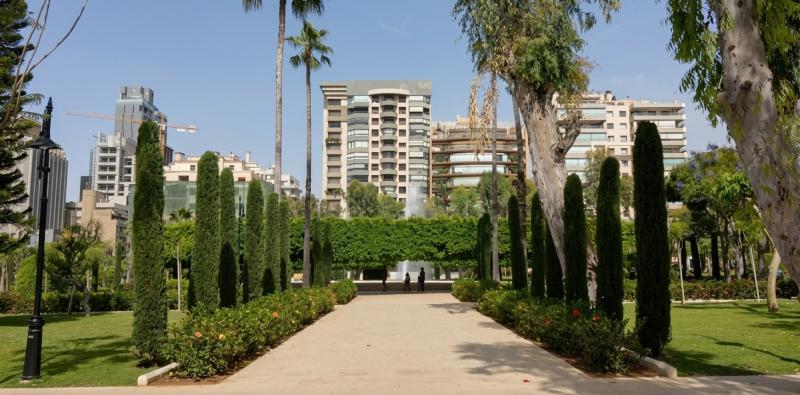
René Moawad Garden in Beirut offers a glimpse into one of the capital's most prominent public parks, widely known among locals and visitors as "Sanayeh Garden." The park's significance stretches beyond its lush greenery, rooted in its early 20th-century history when it was established around an Ottoman institution called "Maktab Al Sanayeh and Al-Hamidi Trade."
Over the decades, this garden has transformed into a communal space blending historical memory with the daily life of Beirut residents. The garden underwent significant renovation, enhancing its facilities and trails to suit walking, sports, and family activities while preserving its historical landmarks.
Location of René Moawad Garden
Situated in the Sanayeh district at the heart of Beirut, the park's central urban location grants easy access from several neighborhoods, providing a green space amidst a densely built environment.
This strategic location has made the garden a haven for locals and visitors, offering an open-air escape from the bustling city streets.
Why is it Known as Sanayeh Garden?
Historically tied to the "Maktab Al Sanayeh and Al-Hamidi Trade" during the Ottoman era, the garden dates back to 1907. Initially, it served as an exterior courtyard for the educational and commercial hub, preserving the "Sanayeh" name even with the official renaming.
Thus, the popular nickname "Sanayeh Garden" persists alongside the official title, becoming ingrained in the locality's identity.
The Official Naming: René Moawad Garden
Officially named after Lebanon's former president René Moawad, assassinated in 1989, the garden honors his memory. Despite this, the historical name linked to the Sanayeh area remains more prevalent.
This dual identity reflects Beirut's character, retaining ancient names alongside newer official ones in its neighborhoods and landmarks.
A Historical Journey from the Ottoman Era
Origins in 1907
The garden's roots trace back to 1907 under Sultan Abdul Hamid II's reign, evolving from local institutions in the Sanayeh region into a well-known public space in Beirut.
These origins embed the garden within Beirut's modern history, while the surrounding Ottoman features amplify its architectural and historical value.
The Hamidi Fountain
A key historical feature, the Hamidi Fountain commemorates Sultan Abdul Hamid II's silver jubilee, established in 1900 and relocated to the garden in 1957.
This fountain is a notable relic of Ottoman architecture in Beirut, enriching the garden's blend of history and modernity.
Garden Renovation
The garden's extensive refurbishment project, launched in 2014 with funding from Azadea Foundation, aimed at enhancing its facilities, landscaping, and accessibility for Beirut's residents.
Upgraded pathways, landscaped areas, and recreational amenities emerged, alongside preservation of historical elements that define the garden's character.
Highlights of René Moawad Garden
The Hamidi Fountain
At the forefront, the Hamidi Fountain stands as a historical emblem, connecting visitors with Beirut's Ottoman era amidst the garden's contemporary landscape.
The Central Water Fountain
The garden features an updated central water fountain with dancing waters reaching heights of up to 20 meters, creating a striking visual interplay with lights and surroundings.
Walking and Athletic Paths
Designed for walking and sports, these pathways cater to those seeking exercise within a green urban setting.
They accommodate jogging, cycling, and scooters, expanding the park's utility beyond just a resting place.
Children's Playgrounds
The garden boasts three playgrounds, providing a recreational space for families in a natural setting.
Plentiful open spaces further invite visitors to relax, unwind, and enjoy a break from urban hustle.
Amphitheater and Cultural Activities
Notably, a small amphitheater hosts cultural events, art exhibitions, and musical performances.
This provides a cultural dimension, transforming the garden into a venue for public events alongside its recreational role.
Flora and Greenery
The garden features an extensive array of trees and plants, offering a refreshing contrast to the surrounding urban environment.
With approximately 800 trees, as reported in refurbishment documentation, the garden serves as a natural refuge within Beirut.
Visitor Activities in the Garden
The garden supports varied activities for all ages; walking among trees, jogging, cycling, and playgrounds cater to families seeking leisure in a natural setting.
For those interested in history and architecture, the Hamidi Fountain offers a glimpse into the past, while the amphitheater enables cultural exploration beyond leisure activities.
Significance to Beirut
Beyond being a public park, René Moawad Garden is a major green space in Beirut, preserving a piece of historical memory.
Such areas are invaluable in crowded cities, providing open spaces for exercise, rest, and social interaction. The garden exemplifies accessible history for youth, distinct from traditional museums.
Historical Oasis Bridging Past and Present
René Moawad Garden's uniqueness lies in its temporal layers, from the Ottoman Hamidi Fountain and the garden's naming after a Lebanese president to modern facilities reflecting current urban needs.
The refurbishment revitalized the garden, incorporating athletic paths, children's playgrounds, an amphitheater, and green areas while retaining its historic essence.
Ultimately, the garden stands out in Beirut, celebrated for its central location, diverse amenities, and historic monuments like the Hamidi Fountain. With a blend of greenery, sports tracks, playgrounds, a fountain, and an amphitheater, it represents a multipurpose space crucial to the urban and cultural landscape of the capital.