


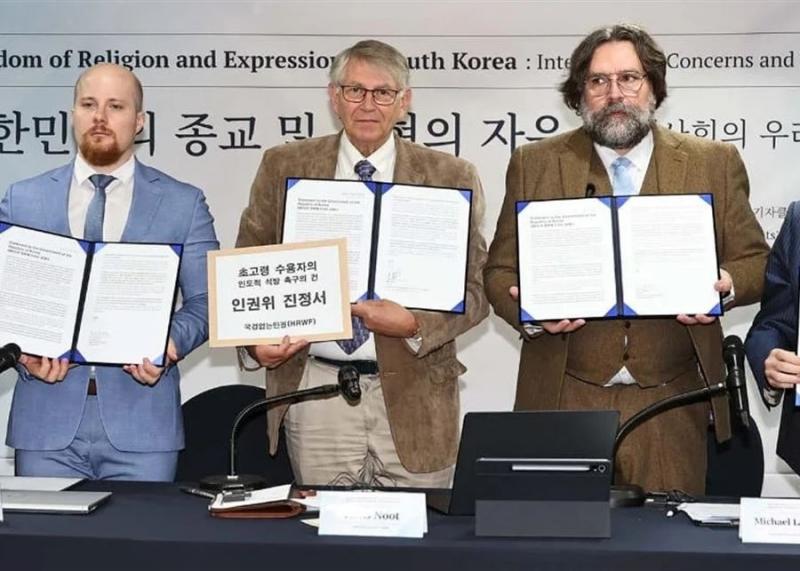
The Human Rights Without Frontiers (HRWF), in partnership with the Conscience and Liberty Association (CAP LC) with ECOSOC status, FOREF, CESNUR, and Bitter Winter, held a press conference today at the Seoul Foreign Correspondents' Club addressing freedom of religion and expression in South Korea.
The conference highlighted concerns regarding the treatment of senior religious leaders held under trial, including issues of proportionality, humanitarian considerations, and due legal process. The organizations appealed to South Korean authorities to review the detention of Lee Man-hee, the 95-year-old leader of Shincheonji, ensuring that legal actions against religious minorities remain neutral and consistent with South Korea's international human rights obligations, including considerations for Hak Ja Han Moon, aged 83, from the Family Federation.
Among the topics discussed were ongoing issues surrounding freedom of religion or belief in South Korea, including the continuing scrutiny of the Seaguru Church in Busan despite the release of Pastor Son Hyeon-bo. Reports questioned conscientious objection, public opposition to the Daegu mosque project, and religious accommodations in educational institutions. Over the decades, Human Rights Watch documented imprisonment of Jehovah's Witnesses in South Korea for conscientious objection, despite the introduction of an alternative civil service viewed as punitive rather than a rights-respecting option, requiring 36 months of service, twice the normal military duration. Recent judicial decisions have upheld these service structures against constitutional challenges.
During his remarks, Hans Noot, Assistant Director of Human Rights Watch, emphasized the issues' significance to democratic society, warning that when religious groups are stigmatized and peaceful assemblies restricted, the consequences extend beyond any single group or issue. The conference sought to advocate for the principle that basic rights apply equally to all.
Thierry Valle, President of CAP LC, addressed the legality of Lee's detention under international law, citing South Korea's ratification of the ICCPR in 1990 and the UNCAT in 1995, questioning the detention of a 95-year-old under these treaties. He emphasized the need to prioritize the presumption of innocence.
Michael Langans, Executive Director of FOREF Germany, provided a legal analysis questioning the necessity of pretrial detention for Shincheonji leader Lee, probing whether evidence was gathered impartially rather than casting the group as a "cult" or "sect." He argued the wider legislative question: can elections' integrity be protected without compromising religious freedom rights?
Mark Niemez, Deputy Director of CESNUR, discussed the impact of ongoing persecution on religious minorities, referencing recent academic studies indicating growing hostility toward the peaceful Shincheonji movement. Niemez highlighted Shincheonji's worldwide religious presence and how adverse actions in South Korea affect its global followers’ rights under ICCPR Articles 18 and 19.
Massimo Introvigne, Managing Director of CESNUR and Editor-in-Chief of Bitter Winter, raised concerns over Lee's arrest, stressing international standards like the Mandela Rules advocating house arrest for his age and non-violent crime accusations. He noted charges based on normal political participation appear overly exaggerated legally, cautioning this reflects broader pressures on religious minorities in South Korea.
The organizations urged South Korean authorities, the media, and the international community to closely monitor legal procedures, proportionality, and equal rights protection, providing further documentation to support ongoing coverage.
Concluding the conference, attendees signed a formal request calling for the immediate release of Leader Lee.