


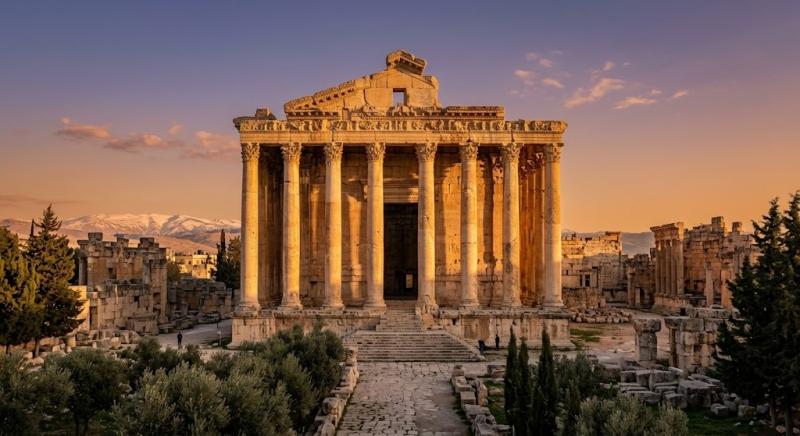
The Temple of Bacchus stands as one of the most renowned landmarks in Baalbek, Lebanon. Situated within the expansive Roman complex, it contributes to the city's reputation as a vital archaeological site.
Despite centuries since its construction, the temple retains many original elements, ranging from its columns and capitals to its intricate stone engravings.
This exceptional preservation offers visitors a relatively clear glimpse into the grandeur of Roman temples during that era.
Beyond its architectural significance, the temple is deeply intertwined with Baalbek's religious and cultural history, marking its transformation into a significant religious hub during the Roman period.
Location of the Temple of Bacchus
The temple is centrally located within Baalbek's archaeological complex, near the Temple of Jupiter, in an area historically known as Heliopolis, or the City of the Sun.
The complex houses numerous massive structures and temples, illustrating Baalbek's religious and political significance in Roman times. Viewing the Temple of Bacchus alone does not suffice to understand its historical importance, as its design and location are integrated into the overall layout of the archaeological site.
Baalbek showcases successive historical layers, predating Roman times and encompassing religious and urban activity before it flourished in the Hellenistic and Roman periods.
Construction Timeline
The Temple of Bacchus dates back to the Roman era, with archaeological studies suggesting its construction spanned the first to second centuries AD.
There is no consensus on the exact year of completion, as it appears to have been part of an extensive urban project continuing over a long period within Baalbek.
During this time, the city experienced significant urban expansion, including the construction of various temples, plazas, and religious sites, establishing it as a major religious center.
Why Named After Bacchus?
The temple's association with Bacchus, the Roman god of wine, festivities, and fertility, is not based on a definitive inscription but rather inferred from architectural, decorative, and symbolic elements found throughout.
These Bacchic features have reinforced its naming, becoming the most widespread when referencing this ancient structure.
Dimensions and Architecture
The Temple of Bacchus is notable for its size, measuring approximately 66 meters in length, 35 meters in width, and 31 meters in height.
These dimensions reveal the magnitude of the Roman engineering project in Baalbek, where the structure combines massive stonework with intricate decorative details.
The contrast between the building's monumental scale and the finesse of its engravings is evident when approaching its columns, walls, and main gate.
Pillars and Entrance
The temple's columns, notable for their Corinthian style richly adorned with botanical motifs, are among the most striking features drawing visitors' attention.
Their capitals intricately exhibit carved leafy designs, showcasing advanced artistry.
These columns served not only a structural purpose but also played an essential role in the temple's aesthetic appeal, contributing to its majestic appearance.
The grand entrance is equally impressive, with detailed stone engravings and symbolic elements reflecting the prevailing beliefs of the time.
Details of the entrance reveal Roman care in melding architectural function with religious symbolism, making it more than just an entryway but a visual statement.
Decorative Accessories
The Temple of Bacchus is distinguished by its ornate decorations, surpassing many other Roman temples preserved to this day.
Decorative elements adorn columns, facades, doors, and interior walls, ranging from plant motifs to geometric patterns and religious symbols.
These detailed features are especially prominent inside the temple, where visitors can appreciate the stone carving precision and quality despite the passage of time.
Preservation of the Temple
A key feature of the Temple of Bacchus is the level of preservation of significant portions of its original structure.
Many columns, walls, and decorative elements have withstood earthquakes, natural elements, political, and urban changes throughout the centuries.
Despite suffering damage and undergoing various restorations, significant parts of the temple still allow researchers and tourists a clear vision of its original form.
These preservation conditions make the temple an invaluable model for studying grand Roman architecture in the region.
Baalbek and Roman Influence
The Temple of Bacchus stands adjacent to the Temple of Jupiter, the largest and most massive of Baalbek's complex temples.
The coexistence of these two temples within the site offers insights into the grand religious project executed by the Romans in Baalbek.
While the Temple of Jupiter was more extensive, the Temple of Bacchus is better preserved, making it one of the site's most famous and visitor-attracting features.
Significance in Roman Times
Baalbek experienced significant architectural and religious growth during Roman times, developing into a prominent religious center.
The city saw the construction of substantial buildings and temples, requiring extensive human and engineering resources, reflecting its status at the time.
The region also witnessed an interaction between ancient local beliefs and Greek and Roman doctrines, visible in the pantheon and decorative nature of the temples.
Visiting the Temple of Bacchus
A visit to the temple provides an opportunity to observe intricate details that may not be evident from afar.
Corinthian Columns
These feature ornate capitals and fine botanical details.
Stone Engravings
Visible throughout the structure, revealing the artistry of ancient sculptors.
Main Entrance
It is among the temple's most distinguished sections due to its size and surrounding decorations.
Interior Walls
Offer a glimpse of the temple's lavish interior design, with a myriad of decorative details.
Temple's Location within the Complex
Its proximity to the Temple of Jupiter and other structures aids in understanding the Roman project’s scale in Baalbek.
Baalbek as a UNESCO Heritage Site
In 1984, the Baalbek archaeological complex was added to the UNESCO World Heritage list, recognizing its extraordinary historical and architectural value.
The site is a paramount example of Roman architecture in the region, representing the interaction of local traditions with Roman influences.
The site’s importance also lies in its monumental scale and diverse architectural elements, alongside its impressive state of preservation.
Is the Temple of Bacchus Worth Visiting?
Absolutely, especially for enthusiasts of history, archaeology, and ancient architecture.
The temple stands out as being relatively easy to imagine in its original grandeur, as large parts of its columns, walls, and decorations remain intact.
Moreover, its location within the Baalbek archaeological complex renders the visit more valuable, allowing visitors to explore a range of Roman era structures and understand their relationships within the vast urban project of the city.
Related Reads:
Best Time to Visit St. Nicolas Stairs | Top Travel Itinerary in Gemmayze | Tourist Spots in Lebanon During Winter