


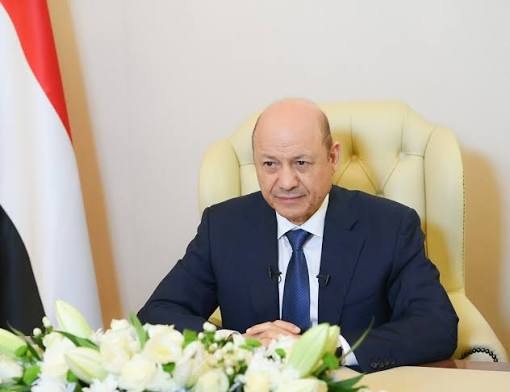
Yemeni Presidential Leadership Council head, Rashad Al-Alimi, vowed on Monday to escalate military operations against the Houthi group. He assured that government forces would continue delivering "painful strikes" on Houthi command and control centers and gatherings across various battlefronts amid mounting clashes and attacks on Yemeni cities and ports in recent weeks.
Al-Alimi made these remarks while meeting with Germany's Secretary of Defense Nies Bolter in Riyadh, Saudi Arabia, where they discussed security and military developments in Yemen and threats related to the Red Sea and Bab al-Mandeb, according to the official Yemeni news agency, Saba.
Al-Alimi stated that the recent Houthi escalation against cities, ports, and civil facilities, including attacks in Mocha and Marib, is an attempt to reuse what he described as a "blackmail policy" and to test the Yemeni government's response capability after years of ceasefire supported regionally and internationally.
He emphasized that the government's armed forces have shown a high level of readiness and operational capability during recent confrontations, underscoring their intent to continue targeting Houthi command centers, gatherings, and elements across various fronts.
The Yemeni government's intensified military stance signifies a response to the recent wave of attacks following a relatively prolonged period marked by reduced extensive confrontations between the parties.
Al-Alimi called on the international community to expand its role in countering networks trafficking in arms and military-use components and technologies reaching the Houthis, while tightening measures against individuals and entities involved in financing and arming the group.
He also urged strengthened international collaboration to prevent military technology and arms from reaching Houthis, amid repeated accusations of Iran providing military and technical support to the group.
Linking the war developments within Yemen with the security of international maritime corridors, Al-Alimi called for increased aid to empower the Yemeni government to secure the Red Sea, Bab al-Mandeb, and ports under its control.
He stressed that relying solely on international military deployment in the Red Sea is not a sustainable solution to maritime threats, asserting that regional security requires a Yemeni state capable of exerting its authority over its lands, shores, and territorial waters.
This call gains importance given Yemen's strategic location at Bab al-Mandeb, a crucial maritime passage connecting the Red Sea to the Gulf of Aden and the Indian Ocean, through which significant international trade and energy shipments pass.
Al-Alimi's stance comes amid escalating military operations since early July, with renewed clashes between government forces and Houthis on fronts in Marib, Al-Jawf, Taiz, and Al-Dhale, coinciding with missile and drone attacks.
Marib city suffered ballistic missile attacks while a similar assault targeted Mocha port, reportedly causing human casualties and material damage, prompting the Presidential Leadership Council to hint at a harsher military response.
The resurgence in fighting raises fears of a collapse in the ceasefire that has been in place since April 2022, despite the absence of a final political settlement to the war.
The Houthi group controls Sanaa and vast areas in northern and western Yemen since 2014, whereas the internationally recognized government and allied forces manage other parts of the country, backed by a Saudi-led coalition.
With the Yemeni government's rhetoric shifting from warnings to hints of targeting Houthi command and control centers, the confrontation enters a more sensitive phase, particularly as internal fronts intertwine with regional tensions and threats to navigation in the Red Sea and Bab al-Mandeb.