


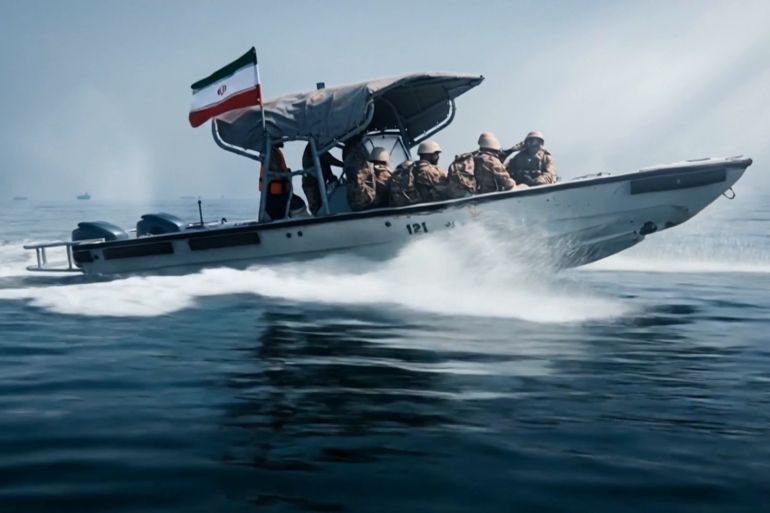
On Friday, Iran's Fars News Agency reported that groups described as "popular forces" set off in boats towards the Strait of Hormuz. This move was reportedly a response to a statement and social media post by U.S. President Donald Trump regarding the strategic waterway.
The agency released a video showing young men, some armed with rifles, on boats heading towards the strait, without revealing the nature of their mission or the entity organizing the movement.
This action followed Trump's post on "Truth Social" featuring a map that included the Strait of Hormuz within what he termed "new American land," provoking outrage from Iran.
The map seemed to be satirical, as it also included areas and entities not legally part of the U.S., such as the Federated States of Micronesia and the Marshall Islands, both independent nations linked to Washington through free association compacts.
Iranian Military Response
Soon after Trump's post was circulated, Iranian central command spokesperson Ebrahim Zoufqayar affirmed that Tehran continues to export oil despite maritime blockades and U.S. pressures.
Zoufqayar claimed that Chinese refineries still import approximately 1.2 million barrels of Iranian oil daily, suggesting that Washington is hesitant to sanction the Chinese refineries and banks facilitating this trade.
In a separate statement, the Iranian official suggested that the remaining option for the U.S. is to respect what he called the Iranian people's will, accept Tehran's conditions, and fulfill its commitments.
Washington Increases Economic Pressure
These developments coincide with U.S. efforts to ramp up economic pressure on Iran. On August 24, U.S. Treasury Secretary Scott Biencent announced that Washington is working to tighten sanctions to cut off Tehran's income sources.
He also hinted at imposing secondary sanctions on entities and countries that do not adhere to the new American restrictions, as part of Washington's strategy to amplify financial pressures on Iran.
Conversely, Tehran associates fully reopening the Strait of Hormuz with the U.S.'s response to its demands, while the waterway has become a critical leverage point in the standoff between the two nations.
The sight of Iranian boats adds a new dimension to the ongoing exchange of messages concerning the strait, amid a complex interplay of U.S. economic pressure, military threats and movements, and diplomatic efforts aimed at establishing new navigation arrangements in Hormuz.