


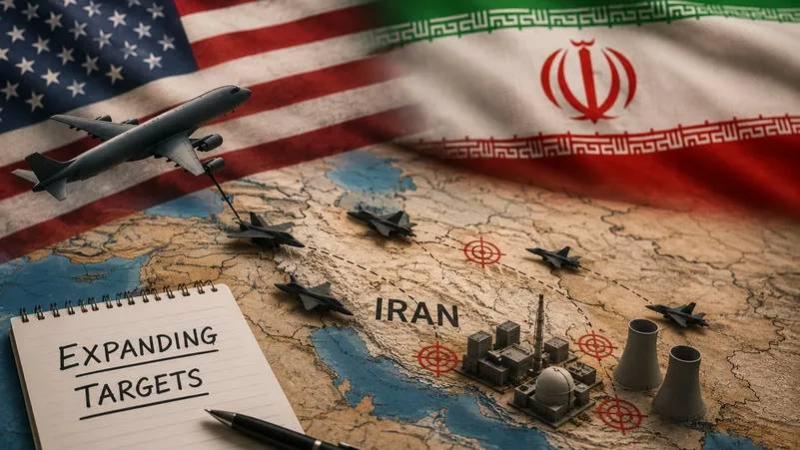
An American official reported that U.S. forces targeted two rocket launchers on Iran’s Larak Island on Sunday, marking the first known U.S. airstrikes on Iran since late July.
Larak Island, strategically located at the Strait of Hormuz near Bandar Abbas port, plays a key role in Iran-related tensions, maritime security, and global energy supplies.
Iranian media claimed Iran retaliated with an attack on Jordan.
On Monday morning, Mehr News Agency cited a statement from Iran’s Revolutionary Guard, claiming it shot down a U.S. MQ-9 drone over the Strait of Hormuz using air defense missiles, causing it to crash into the Gulf waters.
This resurgence of hostilities follows weeks after President Donald Trump's administration intensified efforts to penalize Tehran and its trade partners with costly economic sanctions, avoiding military options.
U.S. Treasury Secretary Scott Beisent told Reuters that new secondary sanctions are likely to be announced weekly as part of efforts to pressure Iran, initially focusing on banks.
Beisent remarked, "We start with banks, telling them it’s unacceptable to hold Iranian funds or aid the regime."
Following sanctions on Friday against Bank Misr branches in the UAE over alleged financial ties with Iran, Beisent suggested the next step could involve fully isolating an institution from the dollar-based financial system.
"You will see more of these actions weekly," Beisent stated to Reuters, before a meeting of G20 finance ministers and central bank governors.
Describing the first known U.S. military strikes since late July, an American official stated forces targeted two Iranian launch platforms on Larak Island.
The source added, "Revolutionary Guard forces were seen preparing to launch missile-loaded naval mines towards the Strait of Hormuz."
In response, Iran launched ballistic missiles at Jordan. Iran’s official TV stated the Jordanian armed forces intercepted eight missiles entering their airspace.
Iranian state media reported the Revolutionary Guard said their attack killed and injured several soldiers and civilians, promising "retaliation and punishment" from Tehran.
The U.S. Central Command stated it undertook "limited and precise" actions against the Revolutionary Guard's mining forces posing an "imminent threat" in the Strait of Hormuz, without detailing specifics.
Following the U.S. strikes, a Fox News correspondent on Sunday cited an American source, claiming Iran attacked Jordan. The correspondent noted "almost all incoming missiles have been intercepted," indicating no significant impact.
Amid shipping threats, shipping data revealed that the number of commodity ships passing through the Strait of Hormuz dropped to five daily over the weekend.
The actual figure might be higher, as some ships have turned off automatic identification systems to avoid attacks.
Last week, President Trump stated all mines have been detonated or removed from the strait's international waters, warning Iran that any ship placing new mines would be destroyed.
Trump reiterated the Strait of Hormuz remains open, but Iran’s Revolutionary Guard Navy dismissed those claims as "blatant lies," asserting the strait remains closed to unauthorized ships.
This waterway once facilitated nearly one-fifth of global crude oil and LNG shipments before closing during the ongoing six-month regional conflict.