


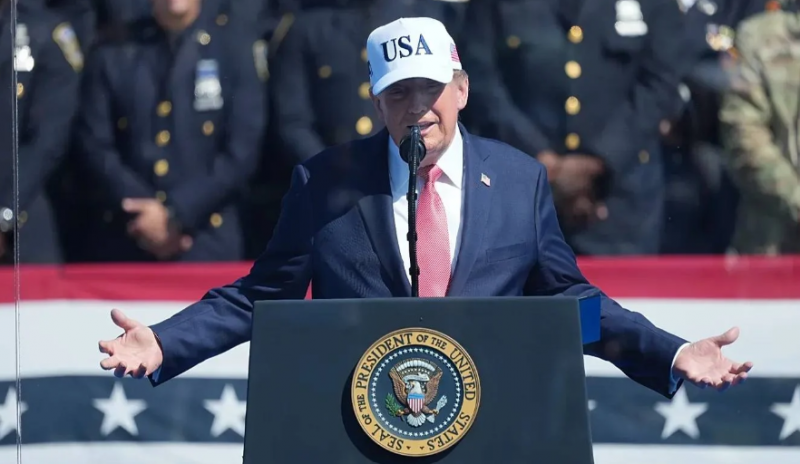
The U.S. Supreme Court has delivered a significant political and legal setback to President Donald Trump just weeks ahead of the midterm elections by halting his administration's plan to change mail-in voting rules. This decision has been met with relief from Democrats, voting rights organizations, and even some Republican officials who warned that last-minute changes could lead to chaos, errors, and widespread delays.
According to a report by journalist Eli Leon in the Israeli newspaper "Maariv," referencing "The New York Times," the Supreme Court on Monday evening blocked the Trump administration's plan to implement significant changes to the way Americans vote by mail ahead of the upcoming midterm elections.
The ruling represents a severe blow to President Trump, who has long repeated unfounded claims of widespread mail voting fraud, according to the report.
The decision is a major victory for Democrat-led states and voting rights organizations that argued the plan was unconstitutional and posed a fundamental threat to the democratic process in the United States, warning that the administration's steps would sow chaos and confusion before early voting commenced.
In a concise one-paragraph explanation, the majority of justices concluded that the administration "is unlikely to succeed on the merits of the case" as additional legal proceedings over the matter concluded.
The ruling was delivered unsigned and without detailing the distribution of the justices' votes, following the protocol for such emergency rulings.
Conservative Justice Brett Kavanaugh penned a separate opinion highlighting that the Postal Service may indeed have federal authority to change the rules, but he argued that implementing changes so close to the election would be "arbitrary and capricious," not allowing state election officials reasonable time to prepare and implement the adjustments.
Conversely, conservative Justices Samuel Alito and Clarence Thomas dissented, arguing that the Postal Service has broad powers to oversee mail operations.
The decision was welcomed by the governor of California, who stated that it was a good day for democracy and the rule of law, adding that Americans now have some certainty about the electoral process 50 days before the election, ensuring safe voting while maintaining mail-in voting options available to those who need them.
The American Civil Liberties Union also hailed the ruling, affirming that voters will determine the outcomes of the November elections, not the White House.
Even Republican election officials expressed relief over the decision.
Ricky Hatch, a Republican official in Weber County, Utah, told "The New York Times" that he felt relieved after the decision.
Utah relies almost entirely on mail-in voting, and Hatch had prepared an emergency plan to cancel this method if the Supreme Court allowed the planned restrictions to proceed.
The Trump administration's plan, based on a renewed executive order issued in March, required states to provide lists of voters pre-approved to receive ballots.
The Postal Service was supposed to deliver ballots only to voters on these lists.
States were also to be required to use Postal Service-approved envelopes with a unique barcode for each voter.
Opponents of the plan argued that redesigning ballots and envelopes at such a late stage was nearly impossible and could lead to critical delays, especially in states that had already begun mailing ballots.
Seven Republican-controlled states also petitioned the court to prevent the last-minute changes due to significant concerns about errors and confusion among voters and election officials.
Despite the ruling, Benjamin Hovland, who was removed by the Trump administration from the bipartisan Election Assistance Commission this year, warned against considering the issue resolved.
Hovland stated that the Supreme Court's decision mitigated the "real-world impact" on voters and poll workers, but emphasized that Trump's actions remain concerning.
He added: "What we see here is the use of government apparatus and federal agencies, plus taxpayer dollars, to push a narrative that only undermines trust in our democracy and ultimately harms voters and election officials."
Thus, the Supreme Court's ruling not only freezes a technical amendment to the voting mechanism but becomes a sensitive political milestone on the road to the midterm elections, especially with Republican officials joining in the warnings that changing rules weeks before the polls could turn the ballot battle into a crisis of trust and organization.