



Sursock Palace in Beirut has announced the cancellation of an event scheduled to be held at the venue following widespread criticism on social media about hosting the wedding of the son of former MP and minister Ali Hassan Khalil. The event had sparked significant backlash online in recent days.
The palace administration expressed regret over what had been circulated across various social media platforms and announced, in a statement, that “after communicating with and coordinating with the relevant authorities, it has been agreed to cancel the event.”
The administration emphasized that Sursock Palace “has always been and will remain open to everyone without discrimination or exception,” considering it a part of Beirut and its history and memory, which is “larger than any dispute or division.”
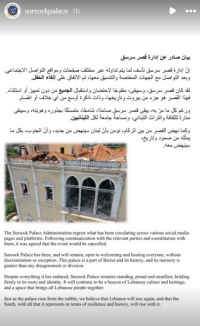
The statement further added that despite everything it has endured, the palace will remain “steadfast and proud, adhering to its roots and identity,” serving as a beacon of Lebanese culture and heritage and a unifying space for the Lebanese people.
In a notable reference to the South, which was central to the criticisms surrounding the event, the administration concluded its statement by asserting its belief that “as the palace has risen from the rubble, Lebanon will rise again,” and that the South, “with all its resilience and history, will rise with it.”
Why did the wedding cause an uproar?
According to “Janoubia,” the controversy began days before the scheduled event as details emerged about the preparations for Ali Hassan Khalil's son’s wedding at Sursock Palace in Ashrafieh, one of Beirut's iconic historic venues hosting weddings and events.
Supporters of the Amal Movement expressed their discontent over hosting what was described as a “lavish” wedding at this time, discussing the possibility of organizing a protest outside the event venue.
The objection, as indicated in the shared posts, was not against the family occasion itself but rather its location, scale, and timing, amid the backdrop of southern Lebanon dealing with the repercussions of war, destruction, displacement, and economic difficulties.
The uproar subsequently expanded on social media, where critics drew comparisons between the scenes from the affected southern towns and the talk of an opulent event at Sursock Palace.