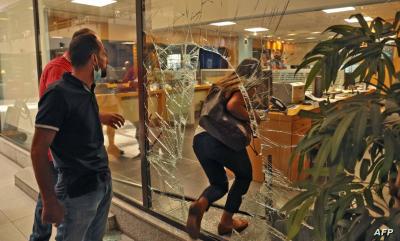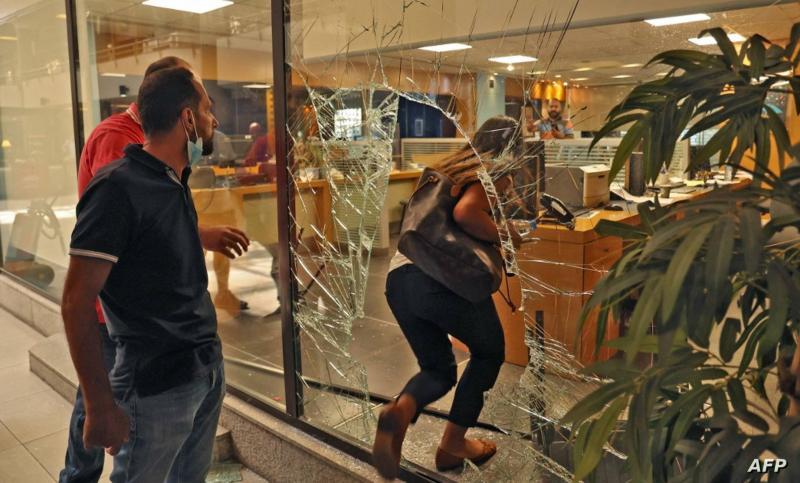
Lebanese banks will reopen their lobbies and branches today (Monday) after a week-long protest closure, demanding a comprehensive plan to ensure the security of employees and clients, and to expedite the approval of legislation that establishes a legal framework regulating withdrawal quotas and liquidity management among stakeholders. This aims to prevent a recurrence of the unrest that followed a series of assaults carried out by angry depositors wielding firearms and incendiary materials.
The banks' return to operation under specific organizational systems for customers will coincide with parliamentary sessions scheduled for both morning and evening to approve the general budget law for the current year. It is likely that representatives of parliamentary blocs will address the contents of the government's recovery plan, which they received via email, particularly regarding the reform laws required by the International Monetary Fund, most notably the law imposing exceptional capital controls.
Reports indicate that entry to bank branches will initially be subject to strict regulatory measures and prior appointments defining the reasons for visits. According to a statement from the banks' association, any customer needing urgent assistance can contact the bank's management or customer service departments. Most regular transactions will be available through ATMs, including withdrawals and cash deposits related to transfers via the "Sayrafa" platform.
While the association hinted at "the lack of adequate state protection," its sources confirmed that the protective measures that banks will adopt individually will aim to ensure the continuity of customer service while taking into account the current difficult security conditions and the need to safeguard the well-being of customers and employees alike. Specific channels will be set by each bank for transactions related to commercial, educational, and healthcare operations, as well as through ATMs for all customers, allowing them to make deposits and withdrawals, and ensuring salary payments for the public sector once transferred from the Central Bank of Lebanon.
Regarding viable solutions to the unrest plaguing depositors, a banking official emphasized the importance of enacting clear legislation that includes "commitment to fairness among customers within the available liquidity capabilities, according to the established criteria for individuals and companies, while also considering the urgent needs for additional justified amounts for some depositors, whether for healthcare, education, or other reasons." The legal framework alone protects everyone's rights and serves as a valid reference for litigation when necessary, providing an ideal alternative to frantic calls for reclaiming full rights by self-means at the expense of equitable distribution of possible quotas amid enforced liquidity restrictions in both the local currency and the dollar.
He noted that the central bank's directives regarding liquidity distributions through banks serve as an appropriate basis for determining available withdrawal quotas, particularly Circular No. 158, which allows depositors to access $800 monthly divided equally between $400 in cash and the other half in the local currency at the exchange rate of 12,000 lira per dollar. Expanding the circle of beneficiaries to include all individual depositors and partially adjusting withdrawal ceilings and exchange rates to be more aligned with platform trading values is also possible, but it requires clear and non-arbitrary definitions for exceptions and additional liquidity provisions.
Moreover, Circular No. 161, which is effective and allows the exchange of lira liquidity for cash dollars through the "Sayrafa" platform—at a rate of $500 per month per individual—can also be utilized. All public sector employees can receive their salaries in cash dollars at the rate set by the platform, primarily targeting partial income protection against the significant difference sometimes exceeding 8,000 lira per dollar in the parallel market, depending on daily exchange rate fluctuations.
In parallel, it was noted that the bank closure for five consecutive working days last week did not significantly impact currency exchange operations in the parallel markets or among money exchange and transfer companies, where most cash exchanges occurred within the range of 37,000 to 38,000 lira per dollar. Approximately $197 million was traded throughout the week via the central bank-managed Sayrafa platform, at a price of 29,800 lira for one dollar. With banks returning to work, check-clearing operations will also return to normal.
According to active market sources, a steady improvement in the lira's value is expected, provided that positive developments affect supply and demand dynamics, especially with the completion of the legislative council's approval of the budget law and the commencement of formulating next year’s budget reinforced by structural financial reforms. This should follow the adoption of a package of reform laws according to the commitments received by the International Monetary Fund’s mission during its three-day meetings with legislative and executive authority figures last week. The monetary markets are also anticipating the outcome of promises and information regarding an imminent agreement between President Michel Aoun and Prime Minister Najib Mikati during this week on a final formula for modifying the current government and renewing trust in it from the legislative council, which would lead to the orderly resumption of cabinet sessions and reflects a further signal of the potential for substantial progress in the maritime border demarcation agreement and its possible future implications for the country and its economy.