


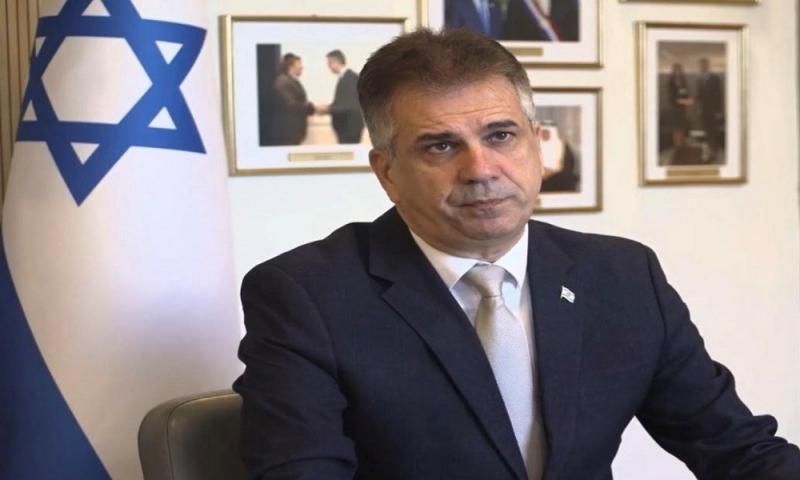
Israeli Energy Minister, Eli Cohen, a member of Prime Minister Benjamin Netanyahu's Security Cabinet, has asserted that Israel will respond forcefully to any attacks originating from Lebanese or Syrian territories. He cautioned that Beirut and its southern suburbs are not exempt from being targeted if Israel faces missile, drone, or projectile attacks.
In a special interview with Al Hurra, Cohen criticized the Lebanese army for its inability to act against Hezbollah, emphasizing that any aggression toward Israel will prompt retaliation anywhere within Lebanon.
Cohen urged the Lebanese government and military to seize a 'historic opportunity' to act against Hezbollah, suggesting the group's position is weakened due to recent Israeli military operations. He stated that Lebanon enjoys American and European support in this matter.
He linked the disarmament of Hezbollah to Lebanon's economic and political future, arguing that the country could reclaim its former status as the 'Paris of the Middle East' if it asserts full authority and curtails the group's military influence. Cohen added that any future stability, prosperity, or normal relations between Lebanon and Israel hinges on Hezbollah being disarmed.
Cohen pointed out that Iranian threats in the Strait of Hormuz and Houthi attacks in Bab al-Mandeb have accelerated efforts to create economic corridors and infrastructure linking the Gulf states to Europe via Israel. These projects have been considered for years, but recent developments have expedited their implementation, with Israel currently advancing regional connectivity plans and pipeline projects at an accelerated pace.
He emphasized that, in his view, Israel represents the most stable and secure route for regional energy and trade projects, given its ability to protect infrastructure and ensure the flow of commerce.
On regional relations, Cohen launched a sharp attack on Turkish President Recep Tayyip Erdogan, accusing him of supporting Hamas and other groups and seeking to expand Turkish influence in the region. He claimed that Erdogan is attempting to assert influence in Syria and possibly Lebanon, stating Israel is not interested in controlling any regional country but is focused on neutralizing threats to its security.
Cohen stressed that Israel is not seeking a direct confrontation with Turkey but will not allow any party to use Syrian, Lebanese, or Gaza territories as platforms for threats. He reiterated Israel's commitment to pursuing all involved in the October 7 attack and preventing Hamas from regaining military capabilities in Gaza.
Regarding the Abraham Accords, Cohen praised them as a successful model for regional cooperation, noting that trade between Israel and nations within the accords has surpassed $10 billion annually, with growing investments and collaboration in technology, tourism, and security sectors.
He stated that Israeli and American actions against Iran have been instrumental in preventing Tehran from acquiring nuclear weapons, contributing to regional stability and averting a nuclear arms race, particularly with countries like Saudi Arabia.
In a pointed remark about Qatar, Cohen demanded Doha clarify its political stance, accusing it of supporting entities linked to Iran and the Muslim Brotherhood. He urged the U.S. to prevent Qatar from playing contradictory roles, suggesting it must choose between allying with the West or siding with extremist forces in the region.