


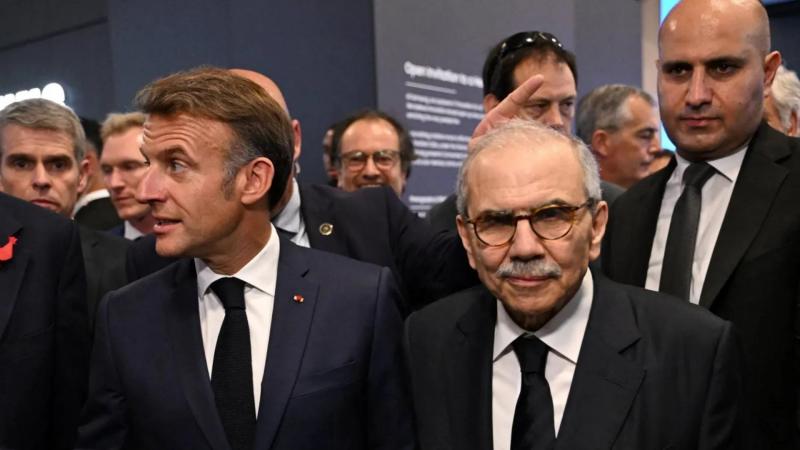
For the first time, France is absent from a body tasked with monitoring the ceasefire between Lebanon and Israel. This occurs with the announcement of the creation of a 'Disengagement Cell' for Lebanon, which includes the United States, Iran, and Lebanon. This cell was established during the U.S.-Iran negotiations held in Switzerland last weekend through Pakistani and Qatari mediation. The cell is expected to replace the ceasefire monitoring mechanism that was previously headed by an American officer. High-level French sources have repeatedly expressed 'astonishment' at the U.S. withdrawal and have called for its reactivation, echoing the demands from Beirut.
However, this exclusion won't deter France from maintaining its focus on the Lebanese issue at the highest levels. Evidence of this is Paris's insistence on making Lebanon a key topic of discussion at the G7 Summit in Evian, and ensuring the summit's main statement includes a section on Lebanon that stresses 'supporting the efforts of Lebanese authorities to disarm Hezbollah and ensure that weapons remain solely in the hands of the state to protect Lebanon's sovereignty and territorial integrity through appropriate international security guarantees.' Notably, this is the first time such guarantees are mentioned, shifting focus from ending the war between Israel and Hezbollah to finding an alternative to the UNIFIL force, whose mandate ends by the end of the year.
Meanwhile, the Israeli government continues to affirm its military's stance on remaining in occupied Lebanese territories, accounting for 6% of its area. A statement from the Élysée Palace following President Macron's talks with Lebanese officials highlighted that 'to establish a solid ceasefire, all parties must respect it. This should initiate a simultaneous process of withdrawal of Israeli forces from Lebanese territories and the redeployment of Lebanese armed forces, ensuring the state's monopoly on weaponry.' The main focus here is the link between Israeli withdrawal, the deployment of the Lebanese army, and Hezbollah's disarmament.
The Élysée statement adds that France is 'ready to actively and practically support this process, and to rally the international community over the coming weeks, alongside the Lebanese government, to support the Lebanese armed forces and address the needs of displaced populations.' Paris, in collaboration with several European countries, the UN, and the United States, is exploring options for forming an international force to replace UNIFIL, emphasizing the urgency of this action as the deadline approaches.
High-level French sources see two main factors that could threaten the U.S.-Iranian agreements: the fate of the Strait of Hormuz and the war in Lebanon. This stems from Iran successfully linking in the framework agreement the cessation of Israeli military operations in Lebanon to its continuation in the agreement.
Given the complexities in southern Lebanon, Paris believes Israeli withdrawal should occur within a framework that is gradual and sequential, in parallel with actions on the other side, such as starting the process of disarming Hezbollah and moving towards the state and its legitimate forces' exclusive control over weapons in Lebanon.
Paris perceives that Israel provides pretexts for Hezbollah to refuse disarmament. What Paris proposes and what the Élysée hinted at—a parallel and gradual process—could offer a way out of the stalemate, avoiding endless cycles according to pragmatic and practical politics.
Other sources suggest that the U.S.-promoted idea of launching 'model' areas, from which Israel would withdraw, with the Lebanese army taking control, could exemplify the principle of gradual and parallel steps. Paris anticipates that current Washington meetings between Lebanese and Israeli representatives, under U.S. sponsorship, may lead to an agreement on some Israeli withdrawal and the Lebanese army replacing it in vacated towns and areas.
On another front, Paris is hastening its Arab and international contacts to schedule the support conference for the army and other security forces initially planned for last March. Both Paris and Beirut agreed to postpone it due to the war's resumption.
Informed sources of ongoing communications emphasize programming the conference in the coming weeks to capitalize on renewed interest in the Lebanese file, including from the U.S., with the hope that the ceasefire agreement holds.
A new addition to this conference is President Macron's inclusion of addressing displaced persons from the war, as stated in the presidential declaration. France is 'ready to tangibly accompany this process, rallying the international community in the coming weeks alongside the Lebanese government, to support the Lebanese armed forces and meet the needs of displaced populations.' Furthermore, the Lebanese issue will be among the topics President Macron discusses during his expected trip to Damascus, reportedly set for the beginning of the second week of July.
France's Exclusion and the Urgent Call for a Support Conference for Lebanon
Share