


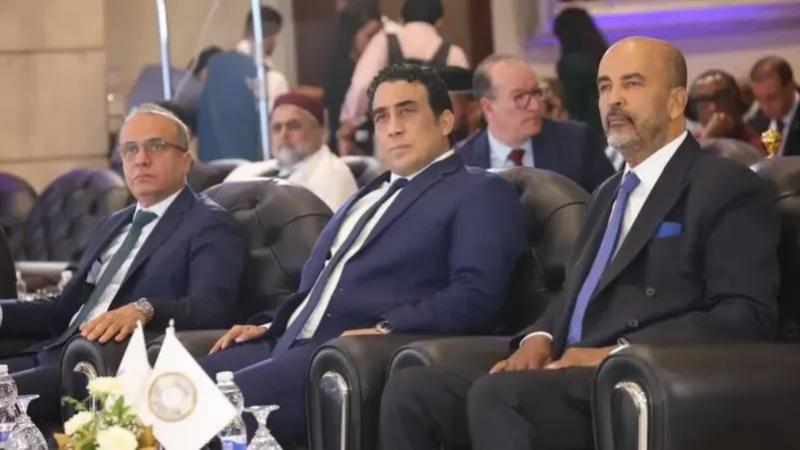
A new political confrontation has erupted within the Libyan Presidential Council following its decision to dismiss the head of the General Intelligence Service. The move has led to internal disagreements within the council, prompting the parliament to warn against involving sovereign agencies in political rivalries.
On Sunday, the Presidential Council announced the dismissal of General Intelligence Service chief Hussein Al-Aib and appointed Abdul Majid Meligta as his successor. This decision was swiftly rejected by Vice President of the Presidential Council, Moussa Al-Koni, who stated that the decision "lacked legal consensus within the council."
Al-Koni issued a statement denying rumors of his absence from the mentioned meeting, clarifying that he participated via virtual communication upon prior invitation. The discussions touched on proposals for appointing the head of the General Intelligence Service and the Chief of General Staff, but concluded without agreement despite attempts to push these proposals through.
He further asserted that claims of collective decisions concluded at the meeting "do not reflect the reality of what occurred," emphasizing that the Presidential Council operates as a collective authority per the political agreement and legal framework governing its actions.
Al-Koni condemned the issuance of statements in the council's name containing unauthorized approvals as a "gross violation of institutional responsibility, misleading public opinion, harming the council's credibility, and undermining trust in state institutions."
Potential for New Crises
House of Representatives Speaker Aguila Saleh also weighed in on the matter, calling for security and sovereign agencies to be kept out of political conflicts. He stated that stirring this issue at such a critical time serves only to sow confusion and disarray.
Saleh warned that ongoing disputes over sovereign institutions could precipitate new crises and deepen divisions, thus obstructing political efforts to unify state institutions and create suitable conditions for elections.
The head of the General Intelligence Service is one of Libya's most significant sovereign and security positions due to the agency's role, making any change at its helm a focal point of political interest and competition, especially amid persistent institutional division and multiple centers of power.
This development comes as Libya experiences rapid political movement following the announcement of agreements among several political leaders to move toward presidential and parliamentary elections, with initiatives underway to resolve the crisis and end the current divide.