


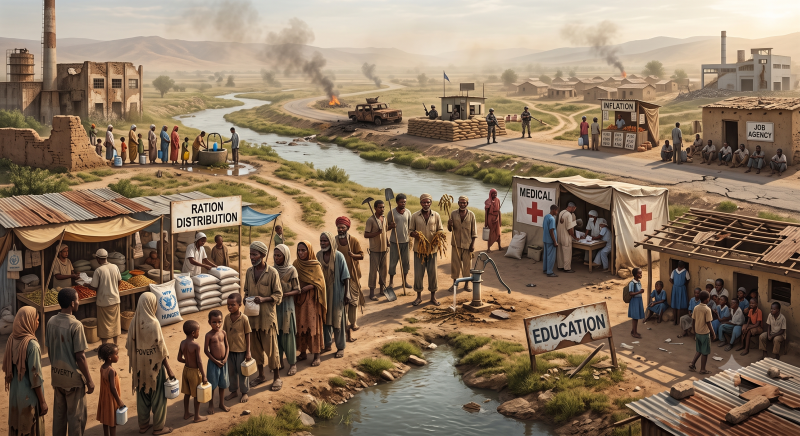
The economic strength of countries across the globe varies significantly. While some nations achieve high growth rates and enjoy high income levels, others face complex economic challenges that hinder development and improve living standards.
This disparity is attributed to multiple factors, including armed conflicts, political instability, inadequate infrastructure, and reliance on a limited-resource economy, along with the impacts of climate change and natural disasters.
The ranking of the weakest economies typically bases itself on GDP per capita, alongside development indicators, poverty levels, and productivity. Despite possessing significant natural resources, some of these countries still struggle to translate these assets into sustainable economic growth.
List of the World's Top 10 Weakest Economies:
South Sudan
South Sudan's economy ranks among the world's weakest, heavily dependent on oil. Internal conflicts and political instability hinder its ability to achieve development and diversify its income sources.
Burundi
Burundi suffers from extremely low average income per capita, reliant primarily on traditional agriculture, with limited investments and high poverty rates.
Central African Republic
The Central African Republic faces significant economic challenges due to prolonged conflicts, affecting economic activity, infrastructure, and investment attraction.
Malawi
Malawi's economy primarily depends on the agricultural sector, making it susceptible to weather fluctuations and droughts, impacting economic growth and income levels.
Mozambique
Though Mozambique has promising natural resources, natural disasters, debts, and security challenges have impeded economic growth's positive impact on the population.
Niger
Niger ranks among the world's lowest-income countries, facing challenges related to desertification, rapid population growth, weak infrastructure, and heavy reliance on agriculture.
Democratic Republic of the Congo
Despite possessing vast mineral wealth, the Democratic Republic of the Congo remains hindered by economic development weaknesses due to conflicts, corruption, and inadequate basic services.
Madagascar
Madagascar's economy faces challenges tied to poverty, weak investment, and an agricultural sector affected by cyclones and climate changes, limiting growth pace.
Somalia
Despite gradual improvement in some economic indicators, Somalia's economy still faces significant challenges due to decades of conflicts and weak institutions and infrastructure.
Chad
Chad's economy heavily relies on oil exports and agriculture. However, oil price fluctuations, coupled with security and climate challenges, restrict sustainable economic growth.
Why Do These Countries Remain at the Bottom of Economic Rankings?
Most weak economies are tied to a set of common challenges, primarily armed conflicts, political instability, weak governmental institutions, and limited foreign investments. Additionally, inadequate infrastructure, high poverty rates, and poor education and healthcare are significant factors.
Moreover, many of these countries' reliance on a single economic sector, like agriculture or oil, makes them more vulnerable to global fluctuations and natural disasters.
Can These Economies Improve?
Yes, some countries previously on the list of the weakest economies have experienced notable growth after implementing economic reforms, improving investment climates, strengthening political stability, and investing in education and infrastructure.
Economists agree that achieving sustainable development in these countries requires long-term plans encompassing economic diversification, job creation, governance enhancement, and more efficient utilization of natural resources.
Conclusion
The list of the world's top 10 weakest economies in 2026 highlights the challenges some countries face in achieving economic development and better living standards. While the reasons differ from one country to another, conflicts, inadequate infrastructure, poverty, and limited economic diversification remain major growth obstacles. Economic reform and political stability remain key to changing this reality.
See Also:
Top 10 Gold Producing Countries in the World
Top 10 Coal Producing Countries in the WorldCountries with the Most Mineral Wealth in the World