


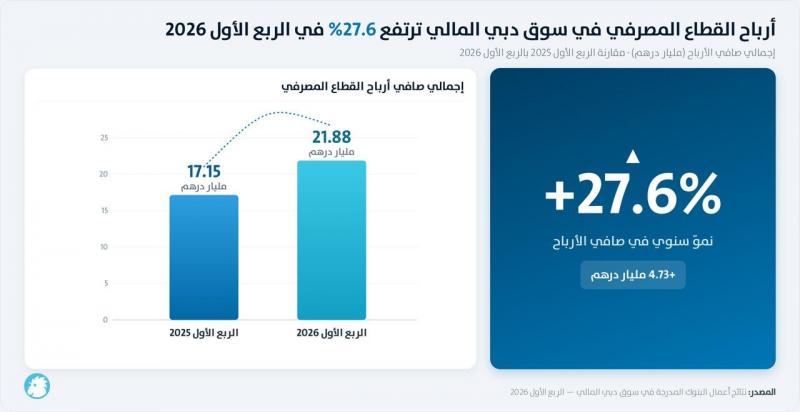
Leading banks listed on the Dubai Financial Market and Abu Dhabi Securities Exchange reported their Q1 2026 results, collectively achieving over AED 21 billion ($5.8 billion) in net profits, marking a nearly 6% year-on-year growth, according to official disclosures and market data.
First Abu Dhabi Bank (FAB) posted a net profit of AED 5.01 billion ($1.36 billion) in the first quarter of 2026, a slight decrease of 2% compared to the same period in 2025, as per an official statement published by Emirates News Agency (WAM).
The bank's balance sheet exceeded AED 1.49 trillion ($400 billion) for the first time, driven by an 8% increase in net loans and advances to AED 668 billion ($181.9 billion) and a 4% rise in customer deposits to AED 871 billion ($237.3 billion).
Hana Al Rostamani, the group's CEO, noted that the performance "reflects the strength of the bank's diversified franchise, disciplined risk management, and robust credit profile, despite the relatively volatile environment at the quarter's end."
The gap between a 6% operational income growth and a 2% net profit decline invites a review of provisions in the bank's detailed financial report.
Abu Dhabi Commercial Bank (ADCB) reported a net profit after tax of AED 3.36 billion ($916 million), a 37.3% year-on-year increase, with pre-tax profits reaching AED 3.78 billion ($1.03 billion), a 30% rise, extending its growth streak to nineteen consecutive quarters.
The bank confirmed it did not activate the proactive support package available from the UAE Central Bank in March 2026, indicating that these results were achieved through its operational capabilities.
Abu Dhabi Islamic Bank (ADIB) achieved a net profit after tax of AED 1.83 billion ($498 million), a 7% year-on-year increase, while pre-tax profit rose by 8% to AED 2.1 billion ($572 million).
The return on equity stood at 27.1%, ranking among the highest levels among listed Islamic banks in the region.
Emirates NBD topped Dubai banks with a net profit of AED 6.41 billion ($1.75 billion), a 3.1% year-on-year growth, bolstered by a 7.1% rise in loans to AED 677.8 billion ($184.6 billion) and a 5.6% increase in deposits to AED 830 billion ($226 billion).
Mashreq Bank was in second place with a net profit of AED 1.93 billion ($525 million), a 7.5% growth, while both Dubai Islamic Bank and Commercial Bank of Dubai stabilized at AED 1.80 billion ($490 million) and AED 830 million ($226 million) respectively, each experiencing marginal growth of 0.2%.
Ajman Bank saw a decline in net profit of 3.8% to AED 129.6 million ($35.3 million), while its loan portfolio grew by 9.7% to AED 19.5 billion ($5.31 billion).
The loans-to-deposits ratio increased from 74.7% to 80.8% over a year, indicating a shift towards faster loan expansion than deposit growth.
Emirates Investment Bank experienced a significant net profit decline of 79.3%, from AED 25.8 million ($7 million) to AED 5.35 million ($1.46 million), marking the largest drop among the listed banks.
No official comment explaining this drop was available from the bank's management at the time of this report.
Credit provisions for banks listed on the Abu Dhabi Securities Exchange increased to AED 2.38 billion ($648 million) by the end of Q1, up 31% year-on-year, indicating a trend of enhanced hedging alongside continued profit growth.
Overall, total assets of UAE operating banks reached AED 5.56 trillion ($1.51 trillion) by the end of Q1 2026, a 17.7% year-on-year increase, according to UAE Central Bank data.