


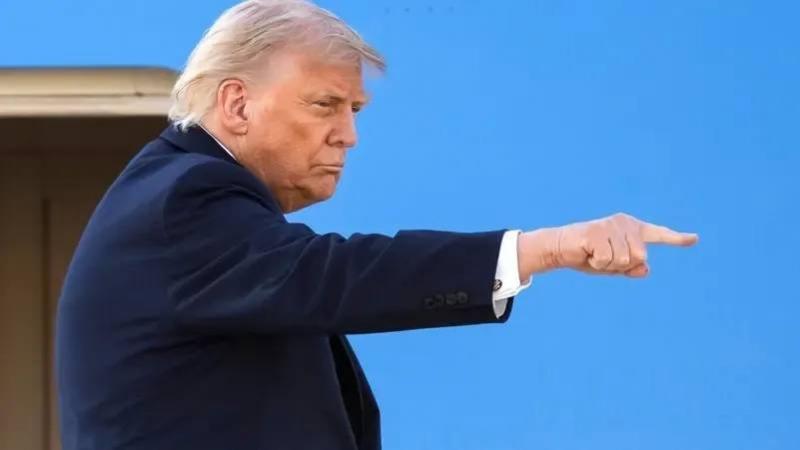
President Donald Trump is contemplating a return to military confrontation with Iran after recent meetings with Defense Secretary Pete Hegseth and General Dan Kain of the Joint Chiefs of Staff. These discussions included options for resuming broad strikes against Iranian targets, according to informed U.S. officials.
Officials revealed that the talks centered on whether the U.S. should abandon negotiations and fully resume military operations, a move some officials deemed as 'completing the mission.' However, Trump has decided to maintain the diplomatic path for now, believing that new attacks might hinder potential agreements to dismantle Iran's nuclear program, as reported by The Wall Street Journal.
Military briefings from the Pentagon are routine, but officials noted that the recent discussions reflect Trump's administration's search for a resolution to the deadlock with Tehran, not ruling out military action if negotiations falter—a tacit admission by some officials of the potential failure of the deal Washington seeks with Iran.
Trump has publicly stated that talks are 'proceeding well,' while emphasizing his willingness to revert to military options if necessary, stating, 'They must agree to everything I want, or we will go back and do what we have to do.'
A White House official emphasized that diplomacy remains Trump's preferred course, urging Iran to seize the opportunity for an agreement with the U.S., while Defense Department spokespeople declined to comment on military plans.
In a Fox News interview, Vice President J.D. Vance explained that Trump's directives allow negotiations ample time, keeping all other options ready if diplomacy does not yield results.
In pursuit of diplomatic efforts, U.S. envoys Steve Witkoff and Jared Kushner have arrived in Doha for a new round of indirect talks with Iran, mediated by Qatar, alongside technical meetings between experts from both sides.
To mitigate tensions, Washington has established a direct military communication channel between U.S. Central Command (CENTCOM) and the Iranian Revolutionary Guard to avoid conflicts, which is reportedly operational according to a White House official, though some view it as still in its infancy.
Official sources indicate that stalled negotiations prompted Trump to ask advisors for new options, with the defense secretary and the chief of staff proposing resumption of extensive airstrikes on Iranian military sites if talks reach an impasse.
Key disagreements persist, such as Iran’s demand for tolls on ships passing through the Strait of Hormuz, opposed by Washington, and Tehran’s refusal of stringent nuclear program restrictions, despite Trump's assertion of Iran's prior agreement to such commitments.
U.S. Energy Secretary Chris Wright criticized Iran's lack of cooperation and reiterated America's commitment to ensuring energy flow through the Strait of Hormuz, 'with or without Iran’s cooperation,' aiming to ultimately dismantle Iran's nuclear program.
Despite exploring military options, U.S. officials report that Trump repeatedly declined to initiate a wide war, threatening previously to target Iranian infrastructure and seize Kharg Island, then retracting to negotiations. He's indicated war will only resume if Iran causes American casualties.
Trump previously claimed the U.S. could bomb Iran for weeks but cautioned such actions would disrupt navigation in the Strait of Hormuz and result in significant casualties, asserting 'an agreement will be stronger than bombing.'
Susan Maloney, Vice President of the Foreign Policy Program at the Brookings Institution, noted that Trump's administration possesses pressure tools beyond war, including delaying the release of Iran’s frozen assets and increasing economic pressures related to Strait of Hormuz navigation.
Maloney added that combining military threats with economic and diplomatic pressures presents challenges but could deter Tehran from escalation, particularly as Trump aims to keep military options open without resorting to a new comprehensive war.