


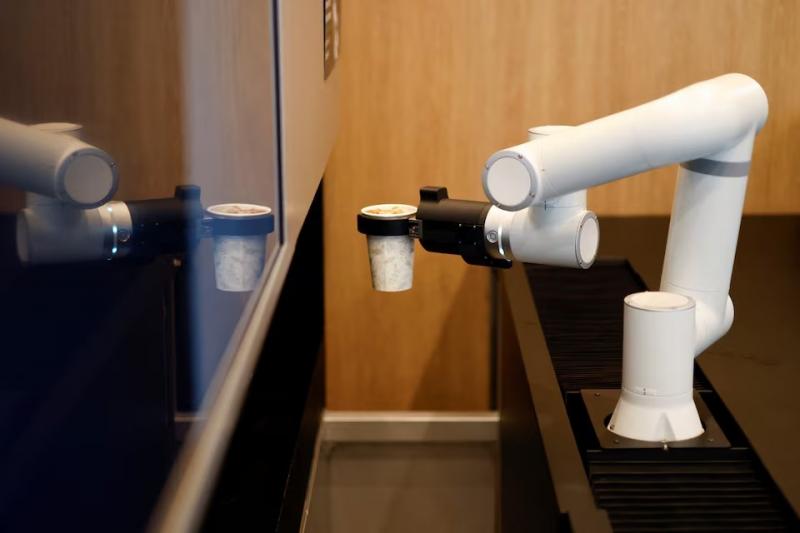
Across South Korea, a growing number of cafes, fast-food outlets, and flower shops are operating without employees. Instead, owners opt for robots and self-service systems to offset rising labor costs, leveraging a business model dependent on the prevalent trust among consumers.
The National Fire Agency estimates that the number of such 24/7 stores will reach 9,000 nationwide by the end of 2024. In addition, Samsung Card, a payment service company, projects these stores have quadrupled in number from 2020 to 2025.
Kim Don-jin, the CEO of Lounge X, where robotic arms serve cups of americano and matcha latte to orders made via interactive kiosks, said, "The number of young workers in their early 20s is declining sharply."
His company operates eight cafes like this, open 24 hours and entirely staff-free, primarily located in Seoul, although human employees prepare coffee at four other outlets.
Unstaffed stores are not novel globally; there are cashier-less grocery stores in countries like the UK and the US. However, this concept has expanded more extensively in South Korea, extending to pet supply and clothing shops.
Store owners attribute the model's expansion to difficulties in finding suitable employees and rising wages, especially since petty crime rates are low in South Korea, where customers typically adhere to the law.
South Korea is experiencing rapid population aging, with one of the world's lowest birth rates, leading to a significant labor force challenge. The government projects the current population of 51.8 million will shrink by about a third to 36.2 million by 2072.