


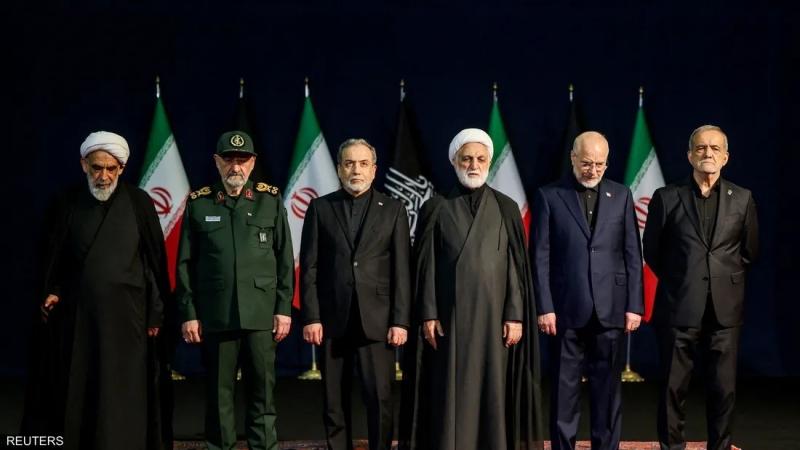
The funeral ceremony for Iran's Supreme Leader Ali Khamenei has temporarily united a deeply divided political and military elite, sparking growing questions over the absence of his successor, Mojtaba Khamenei, from the public scene since he ascended to power last March.
Senior officials and military leaders, who haven't been seen publicly together for weeks, walked side by side during the ceremony. Leading the procession were President Masoud Bazeshkian, Parliament Speaker and chief negotiator Mohammad Bagher Ghalibaf, alongside the head of the judiciary and top generals from the Revolutionary Guard. The organizers aimed to project an image of "unity and continuity" within the regime.
However, the absence of Mojtaba Khamenei highlighted ongoing behind-the-scenes conflict concerning the country's administration and decision-making, particularly regarding diplomatic negotiations with Washington.
According to The New York Times, the previous Supreme Leader's absence, who held the final say, has led to pronounced rifts within the conservative Iranian camp, splitting into two main wings: the pragmatic faction including Bazeshkian, Ghalibaf, and Supreme National Security Council Secretary General Mohammad Bagher Zolghadr, supported by Revolutionary Guard leaders.
This faction pushes for a "grand deal" with Washington, which includes a ceasefire and the lifting of the naval blockade to rescue the failing economy.
Conversely, the other faction is the hardline minority that opposes any political or nuclear concessions to the U.S. administration, demanding military retaliation and prolonging the confrontation, accusing the negotiation team of "collusion and betrayal."
Behind the Agreement
Four Tehran-based officials told The New York Times that Mojtaba Khamenei's "in-principle" decision to advance agreements with Washington came under severe economic pressure.
Sources reported that Bazeshkian informed the new leader in a closed meeting that the American naval blockade "paralyzes the country" and threatened to resign if the agreement was rejected.
Central Bank Governor Abdolnaser Hemmati reinforced this stance with a cautionary message warning of depleting essential goods and medical supplies by the end of August due to hindered oil exports and difficulties in finding alternative trade channels.
These pressures led to the Supreme National Security Council voting 12 to 1 in favor of accepting the agreement and initiating direct talks with U.S. officials, including Vice President J.D. Vance.
Collective Leadership and Media Fracturing
Recently, a marked shift has been observed in Iran's governance structure towards "collective leadership," contrasting the absolute rule practiced by Khamenei Sr.
In a statement reflecting this change, Deputy President for Executive Affairs Mohammad Jafar Qaem Bana said before government officials that the new leader's opinions are "subject to debate and scrutiny like any other official's," questioning, "If our role is merely to implement the Supreme Leader's views, why do we have a Parliament and a Supreme National Security Council?"
Simultaneously, a struggle on official platforms ensued, as live television broadcasts were abruptly cut off during Ghalibaf's presentation of a ceasefire agreement, amidst repeated attacks by state television on the negotiating team.
Videos also captured Foreign Minister Abbas Araghchi being harassed with hostile chants by Iranian visitors while in Iraq organizing the external aspect of the memorial.
Conversely, Iranian military sources attribute Mojtaba Khamenei's continued absence from the public eye to "serious security concerns."
Officials stated that security agencies denied the leader's request to lead the funeral prayer in Mashhad on July 9, fearing potential Israeli assassination attempts or tracking of his secret residence.
Analysts and political figures in Tehran see the imminent appointments following the funeral, including heads of the judiciary, broadcasting authority, Basij forces, and the leader's office, as pivotal in determining which faction the new leader will favor.