


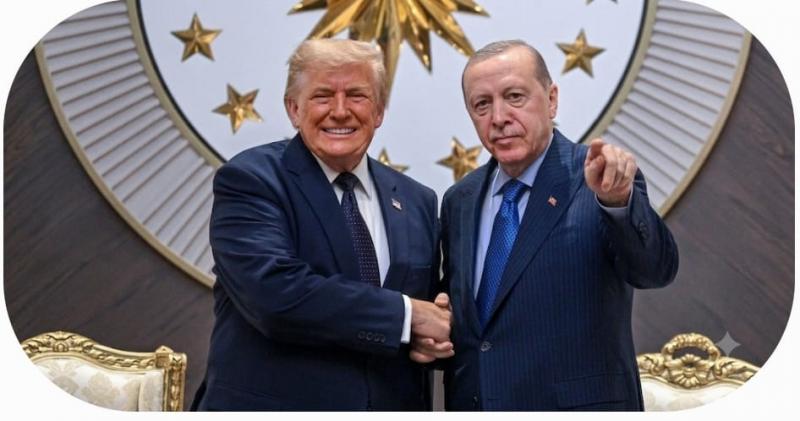
U.S. President Donald Trump received a warm welcome from Turkish President Recep Tayyip Erdogan in Ankara yesterday, where the annual NATO summit is being held. This occurs amidst tensions in U.S.-European relations, highlighted by strife over the conflict with Iran and U.S. pressure on Europeans to increase defense spending. Trump engaged in discussions with Erdogan, emphasizing his strong personal relationship with the Turkish leader as the primary reason for his attendance. He indicated a forthcoming decision on whether to sell Ankara F-35 fighter jets, despite a congressional ban, praising Turkey's loyalty above other nations that have acquired these jets. Trump also mentioned plans to lift sanctions on Ankara for purchasing a Russian air defense system. Trump joined NATO leaders for dinner yesterday, with the main meeting and joint statement from the summit scheduled for today.
Erdogan expressed optimism about reaching an agreement to buy F-35 jets and American-made jet engines for Turkey's Ka'an fighters. He stated Turkey was "promised" five F-35 planes, while Israeli Prime Minister Benjamin Netanyahu cautioned that America granting Turkey F-35s could disrupt the Middle East power balance and threaten Israel's aerial superiority. Netanyahu argued Ankara is not a "model ally" for Washington, accusing Erdogan of "threatening to destroy my country, the only Jewish state."
Meanwhile, Trump declined to reveal any intentions of announcing additional troop reductions in Europe, stating, "We’ll see," and renewed his criticism of NATO, admitting he had considered not attending the summit. Trump's description of Italian Prime Minister Giorgia Meloni as "a nice person" came alongside criticism of her for not aiding in the fight against Iran. Despite acknowledging no changes in the Russia-Ukraine conflict, Trump remained optimistic about a peace agreement and reported positive discussions with Russian President Vladimir Putin and Ukrainian President Volodymyr Zelensky, with whom he is scheduled to meet today. Trump stated, "Putin and Zelensky want to settle this now... I think we will get the settlement. I hope it’s soon." He reiterated a desire for U.S. control over Greenland, arguing Denmark "does not actually spend money to assist Greenland," highlighting the strategic importance of the region for U.S. security.
Concurrently, Zelensky, at NATO's defense industries forum on the sidelines of the Ankara summit, advocated for Ukraine's experienced forces to bolster NATO's defenses, renewing calls for Kyiv's alliance membership. He urged Ukraine's supporters to enhance support for the country’s air defenses, noting current production levels of American-made Patriot missiles are insufficient. He called on allies to press Washington to license Kyiv to manufacture these missiles and encouraged Europeans to collaborate with Ukraine to produce a cost-effective version of these technologies. Zelensky revealed a "drone deal" agreement with Denmark, marking the ninth such deal for Ukraine.
NATO Secretary-General Mark Rutte announced several contracts to bolster the alliance’s defense capabilities, valued in the billions of dollars. A NATO diplomat told the "Agence France-Presse" that the contracts total over $50 billion, confirming a major agreement with Sweden’s Saab to replace Boeing’s current NATO-owned AWACS surveillance aircraft with ten GlobalEye planes, though the deal value remains undisclosed. European aerospace group Airbus secured a contract to supply NATO with a tenth A330 MRTT multi-role tanker transport aircraft.
Additionally, U.S. Secretary of State Marco Rubio and his South Korean and Japanese counterparts agreed to a trilateral cooperation deal on the sidelines of the NATO summit. This aims to "enhance our shared security interests and pave the way for partner nations to meet their energy security needs," according to the U.S. State Department. The memorandum of understanding between the three nations seeks to expedite the deployment of advanced nuclear reactors in other countries, initially focusing on the Indo-Pacific region. Washington also committed to over $10 million in new funding for a State Department program to provide technical support to the countries involved.